Stripe Didn't Buy a Model. It Bought the Layer Between Models and Money.
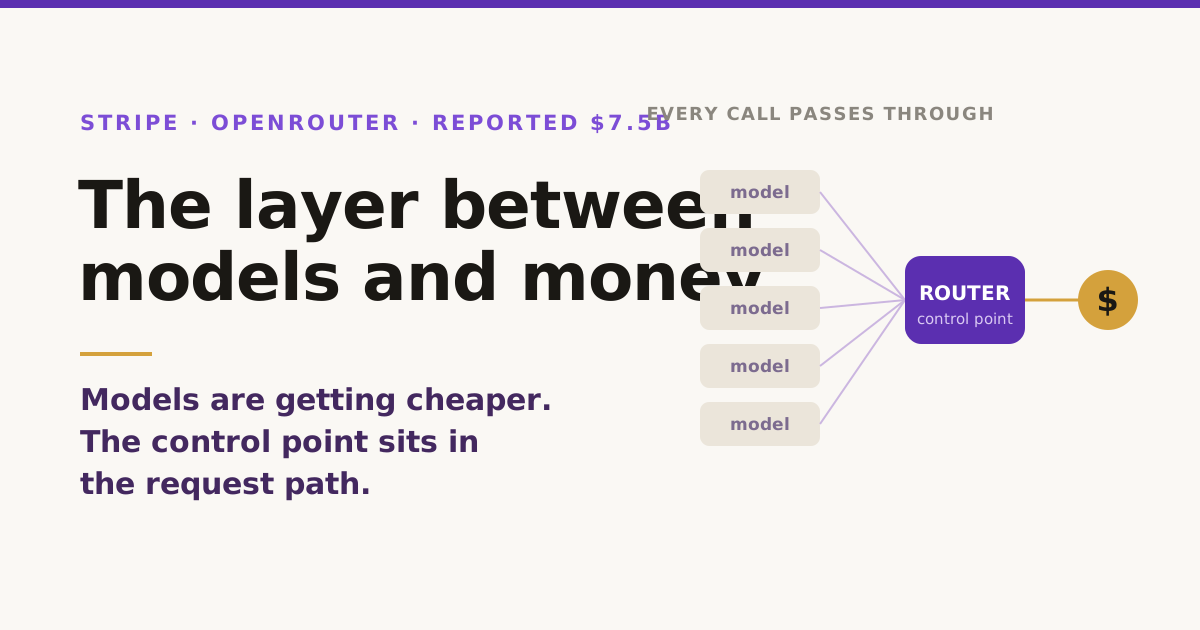
Stripe agreed to acquire OpenRouter on August 19. The companies did not disclose the price, but The New York Times reported it at $7.5 billion [1] [2]. What caught my attention was not the size of the deal. It was what Stripe chose to buy. OpenRouter does not train frontier models. It sits between applications and the models they call, and it helps decide where a request goes, through which provider, at what price, and what happens when that provider is unavailable. For an industry still obsessed with model rankings, that is a surprising place to spend a reported $7.5 billion.
I discussed the deal recently with Aaron Baughman and Mihai Criveti on the Mixture of Experts podcast [3].
Why does a payments company want to own part of the path between an application and an AI model?
The more I look at it, the more the deal makes sense.
What OpenRouter actually does
OpenRouter gives developers a common API for accessing hundreds of models across more than 80 providers [1].
Without a gateway, a team working with several model providers has to manage separate APIs, credentials, pricing structures, rate limits, contracts, SDKs, and failure modes. OpenRouter puts a layer in front of that complexity.
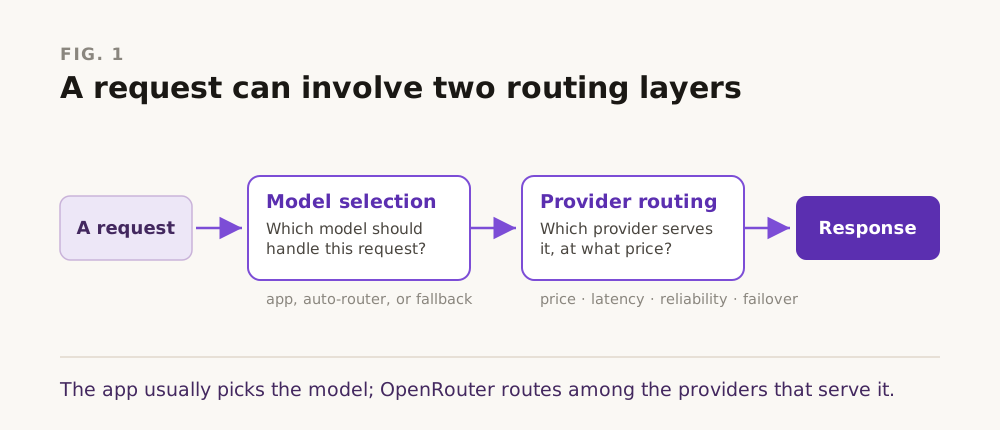
There are really two routing problems here. The first is model selection: which model should handle this request? In most cases the application names the model directly, but the choice can also be made by an automated router or by a fallback policy. The second is provider routing: once a model is chosen, if several providers serve it, which one should run the request?
When model selection is automated, it can work in two ways. Heuristic, rule-based routing follows explicit policies: a cost cap per request, a preferred model with a cheaper fallback, or a rule that certain traffic always uses a specific model. Semantic routing looks at the request itself and decides where it should go based on prompt complexity or embedding similarity, sending simple prompts to a small model and escalating harder ones to a stronger model. A speculative variant tries the cheaper model first and escalates only when its answer is not good enough. Rule-based routing is predictable and easy to audit. Semantic routing can cut cost further, but it adds its own classification step and can misjudge a request.
OpenRouter supports both approaches, and it also offers an automatic router that will pick a model for you. Provider routing can take price, throughput, latency, and reliability into account. Provider failover can happen automatically, and cross-model fallback can also be configured when an application needs it [4].
That distinction matters. This is more than a load balancer randomly moving prompts between models. It is becoming part of the operating layer around model inference. And once you run AI applications in production, that layer matters a lot.
Anyone who has operated across multiple providers has seen some version of the same problems. Rate limits change, endpoints fail, prices move, new models appear, old models get updated, and the prompt that worked yesterday behaves differently after a provider change. At that point, "just call the model API" stops being an architecture.
Why routing matters more in a multi-model world
A lot of AI discussion still assumes an application chooses a model and builds around it. Production systems are becoming more complicated than that.
A workflow might use a small model for classification, a stronger model for reasoning, another model for code, an embedding model for retrieval, and several tool calls around them. An agentic system can generate even more model calls as agents invoke tools, delegate work, or call other models. Mihai described the direction on the podcast as "multi-model, multi-modal, multi-agent, multi-framework, multi-cloud, multi-everything" [5].
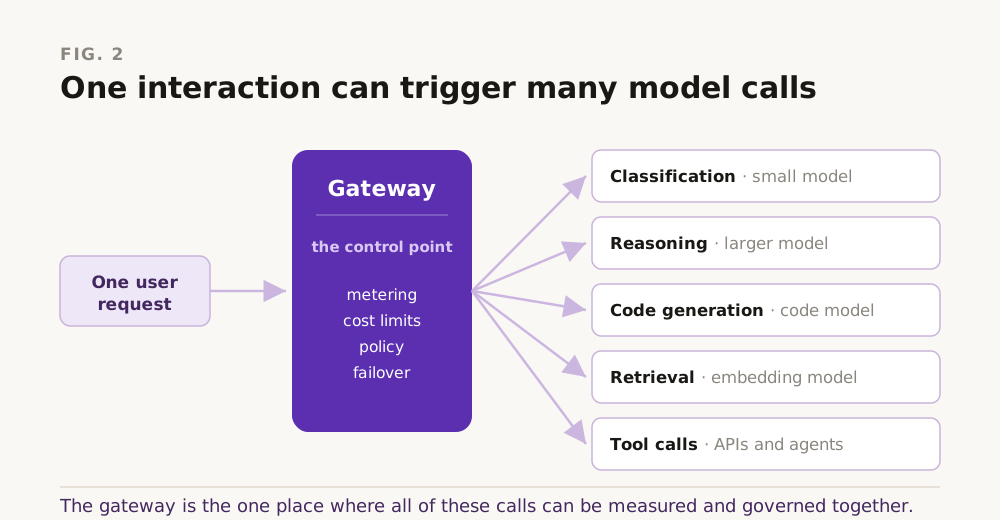
Once that happens, model selection becomes a systems problem. You need to decide when the more expensive model is actually worth using. You need fallback behavior when a provider slows down. You need to know which customer or agent generated the spend. You may want different cost ceilings for different workloads. You may also need policies around which models or providers are allowed to see particular data.
Latency and throughput are not the same target either. An interactive chat or a code assistant that streams tokens to a person cares about time to first token (TTFT), the delay before anything appears on screen. An asynchronous agent or a batch job cares about tokens per second (TPS) and total throughput, because nobody is watching the stream and the only thing that matters is how quickly the whole job finishes. A router that understands this can send interactive requests to whichever provider gives the lowest TTFT right now and send batch and agentic work to whichever provider gives the highest sustained TPS.
The gateway becomes one of the places where those decisions can be made consistently.
I think that is the more useful way to look at OpenRouter. Its value comes less from forwarding requests and more from sitting at a point where model usage can be measured, priced, and governed.
About my "toll booth" comment
On the podcast, I put the argument rather provocatively:
"Models are cheap, and the toll booth is where the money is."
I do not mean that frontier models are cheap to train or serve. They clearly are not. What I mean is that access to capable models is becoming more competitive and, for many workloads, more substitutable.
The toll booth is a figure of speech, not a claim that OpenRouter takes a cut of every call. It has not historically marked up inference [9]. The point is about position. It sits in the path of the request, and a position in a high-volume path tends to be worth something.
There are more strong models. Prices change quickly. Open-weight alternatives improve. A workload that required the most expensive frontier model six months ago may not require it today. That changes where the engineering effort should go.
If several models can solve a task well enough, the valuable question becomes which one you should use for this request, at this moment, at this price. That is a routing question. And once millions of those decisions are happening every day, the infrastructure making them becomes economically important.
Why Stripe is a surprisingly logical buyer
At first, a payments company buying an AI router sounds strange. It becomes less strange when you look at what AI usage does to software economics.
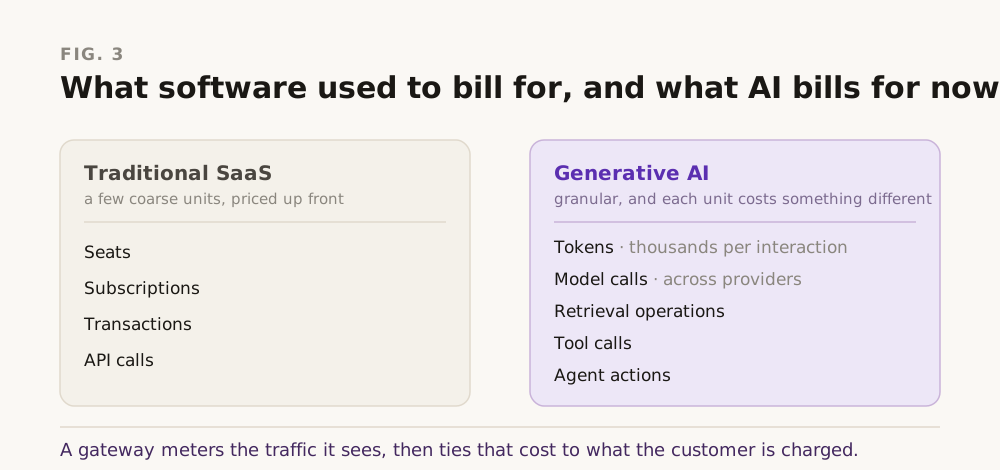
Traditional SaaS often gives companies relatively simple units to bill for: seats, subscriptions, transactions, storage, or API calls. Generative AI introduces a much more granular cost structure. A single customer interaction can trigger thousands of tokens, several model calls, retrieval operations, tool calls, and potentially actions from multiple agents, and those calls may have very different costs.
Someone has to meter all of that. Someone also has to connect the cost of serving the request with what the customer is eventually charged. That is already very close to Stripe's core business.
And Stripe was not starting from zero here. Even before this deal, OpenRouter was already using Stripe for invoicing, tax, and fraud management [7]. Stripe had also begun building products specifically around AI economics, including token billing and infrastructure for usage-based AI businesses [1].
Stripe has also been buying its way deeper into this stack. In January 2026 it completed its acquisition of Metronome, a usage-based metering and billing platform [8]. Put the steps in order and a chain appears. Something selects the model and the provider. Something meters the tokens and calls. Something turns that usage into a price. Something moves the money and handles tax, fraud, and settlement. Metronome strengthens the metering and billing links, OpenRouter reaches back toward the selection step, and Stripe already owned the payment end.
So this does not read to me like Stripe deciding to become an AI company. It reads like Stripe moving one layer deeper into the economics of AI applications. Instead of only processing the revenue after an AI product is used, Stripe gets closer to the decision that sets how expensive that usage is in the first place.
Then there is agentic commerce
There is another reason Stripe may care about being in the request path. Agents are starting to do more than generate text. They can call APIs, buy services, consume compute, make reservations, and eventually transact with other software. That creates a new set of infrastructure problems.
An agent acting for a user or a company needs delegated authorization. It needs spending limits. It needs payment credentials that do not expose the user's underlying financial information. And someone needs an audit trail explaining what was purchased, under whose authority, and within which policy.
Stripe is already building in this direction. At Sessions 2026, the company introduced Link wallets for agents and expanded its agentic commerce infrastructure. It is also working with Tempo on the Machine Payments Protocol for programmatic machine payments [6]. Other companies are moving quickly as well. Google has introduced the Universal Commerce Protocol, and Mastercard and Visa are developing or supporting their own approaches to agent-initiated payments.
The standards are far from settled. But if agents eventually choose both which model to use and which service to buy, then routing, metering, and payment could start to look like adjacent problems. Owning infrastructure that already sees the model request would give Stripe a natural place to connect them.
The caveat: routing itself can commoditize
There is an obvious objection to this thesis. Routing is not especially hard to copy. Aaron Baughman raised this point in our discussion. There are already commercial competitors and open-source routing frameworks, and a company can also build fairly sophisticated routing logic internally.
I think that criticism is right. If OpenRouter were worth $7.5 billion simply because it can forward a prompt to a cheaper model, I would have a hard time understanding the valuation.
The stronger bet is what can be built around routing: usage metering, cost controls, provider selection, observability, caching, policy enforcement, billing, and settlement. Those capabilities are much harder to treat independently once AI usage becomes large enough. OpenRouter does not own all of them at enterprise depth today, and part of what Stripe is paying for is the chance to build them out.
Enterprise policy is where this gets sticky. A large company cannot send regulated data to whichever model happens to be cheapest. It needs zero-data-retention (ZDR) agreements so that prompts and outputs are not stored or used for training. It needs data residency guarantees so that EU or healthcare traffic stays in the right jurisdiction for GDPR or HIPAA. It often needs dynamic PII filtering that redacts sensitive fields before a prompt ever reaches a third-party provider. A centralized routing layer is the natural place to enforce all of this, and once a company has wired its compliance rules into that layer, moving off it is expensive. That switching cost is what turns routing from a feature into infrastructure.
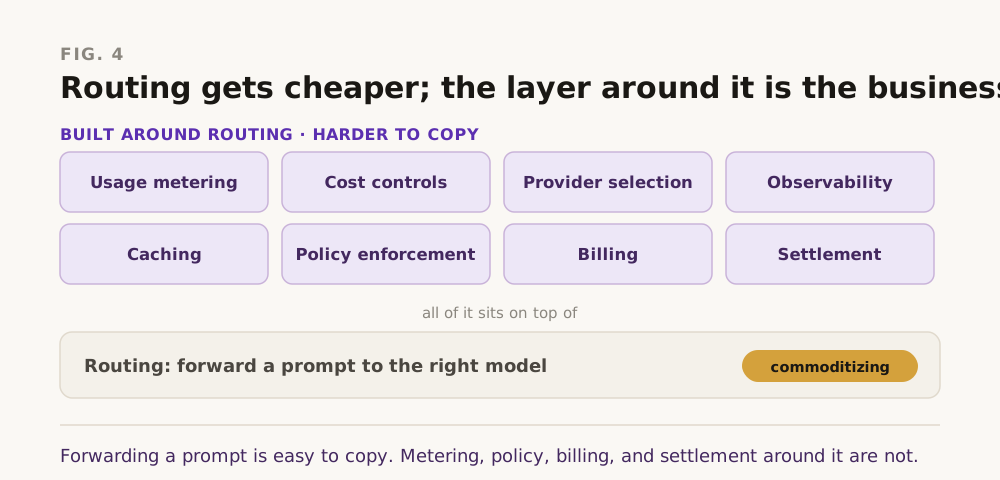
Routing by itself may become a commodity. But routing connected to the economics and governance of AI workloads can become infrastructure, and that is a much stronger business.
The systems view
This is also why the deal feels familiar to me from the systems side of AI. In inference, the model matters enormously, but model quality alone does not determine whether a production system works well. Memory management matters. Scheduling matters. Batching, caching, the runtime, and the serving architecture all matter. I have written before about the KV cache and memory bottleneck and the economics of running tokens at scale for exactly this reason.
The same principle applies one level higher. Once you have several capable models available, the question is no longer only which model is best. It becomes: which model gives me the best outcome for this request under my latency, cost, reliability, and policy constraints?
The model determines the available capability and has a major influence on cost and latency. The routing layer is where you decide how to trade those properties against one another. That is why I would spend less time chasing every benchmark leader and more time thinking about the infrastructure that decides when each model should actually be used.
What I am watching next
There are three things I want to see as the deal closes and the two companies begin integrating.
The first is neutrality. OpenRouter's value comes partly from sitting across the whole model market rather than belonging to any single provider. Stripe and OpenRouter have both emphasized neutrality, and developers will notice quickly if that changes.
The second is how payments and routing converge. Does OpenRouter remain mostly an AI gateway, or does Stripe start connecting model selection directly with token billing, budgets, agent wallets, and machine payments? That would tell us much more about the real acquisition thesis.
The third is where the margins end up. Basic routing will probably become cheaper. If that happens, the durable business is unlikely to be a fee simply for forwarding model calls. It will be the higher-level infrastructure around those calls: governance, billing, optimization, settlement, and enterprise control.
That is why I think the OpenRouter acquisition is worth watching. Models still set the capability frontier, and the best of them are still hard to build. But as capable models multiply, more of the leverage moves to the layer that decides how that capability gets used, what it costs, and how it gets paid for.
Stripe agreed to pay a reported $7.5 billion to move one layer closer to it.
References
[1] Stripe, "Stripe agrees to acquire OpenRouter to help businesses optimize token routing and usage," Aug. 19, 2026.
[2] The New York Times, "Stripe Buys A.I. Start-Up OpenRouter for $7.5 Billion," Aug. 19, 2026.
[3] IBM Mixture of Experts, "Stripe buys OpenRouter, Ramp's AI Index & IBM's OpenAI deal," Aug. 2026.
[4] OpenRouter, "How OpenRouter Model Routing Works: Providers, Fallbacks & Auto Router," June 12, 2026.
[5] Aili McConnon, IBM Think, "Stripe's OpenRouter deal shows where the AI money is moving," Aug. 21, 2026.
[6] Stripe, "Stripe builds out the economic infrastructure for AI with 288 launches," Apr. 29, 2026.
[7] Stripe, "Stripe powers OpenRouter's global AI model access for millions of developers," Jan. 29, 2026.
[8] Stripe, "Stripe completes acquisition of Metronome," Jan. 14, 2026.
[9] OpenRouter, "Frequently Asked Questions," accessed 2026.
Discussion
Sign in with GitHub to leave a comment or react. Threads are public and live in this site's GitHub Discussions.