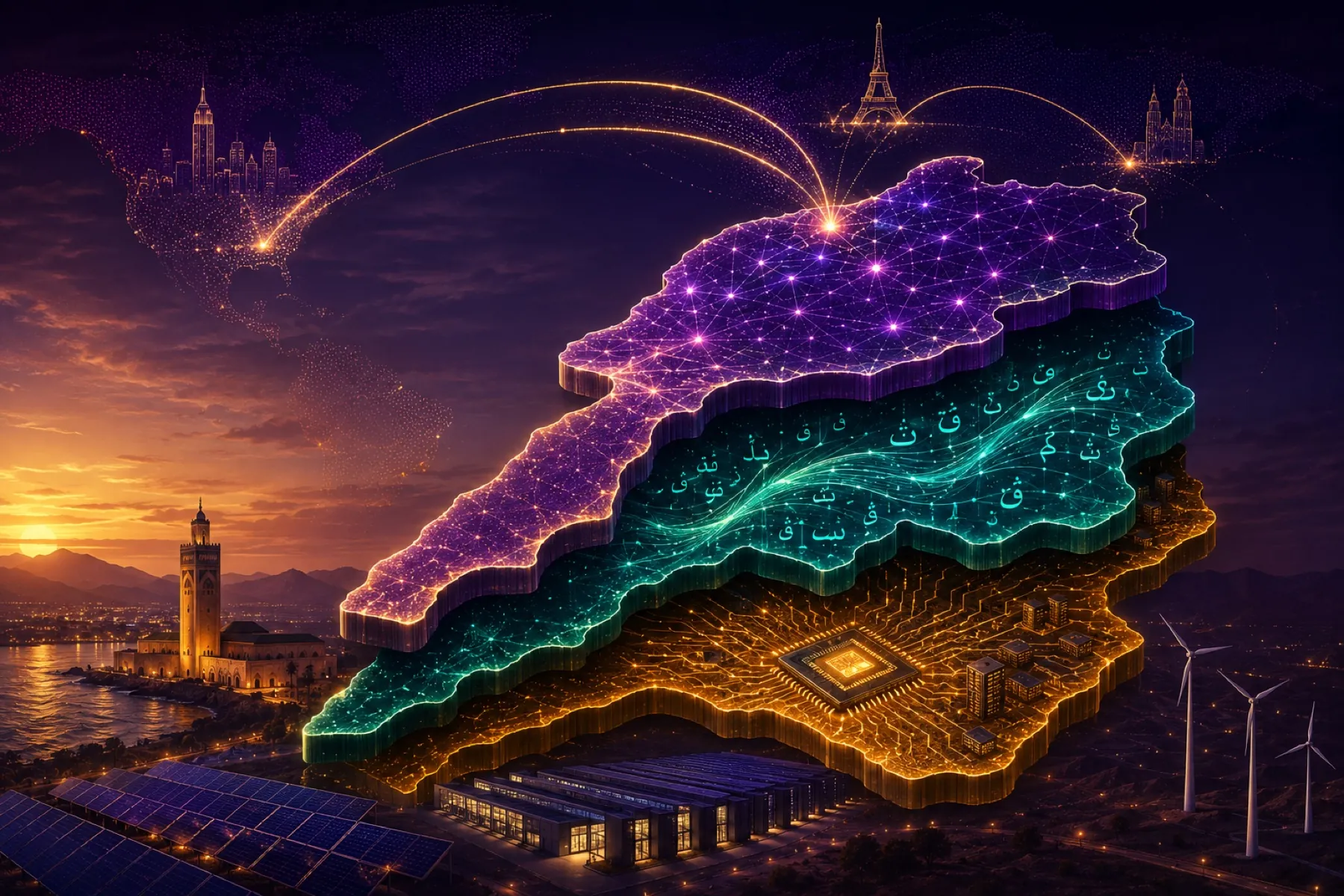
Morocco is building one of Africa's most ambitious AI foundations. But the real question is no longer whether we can build data centers. It is whether we can build the software, models, and talent pipelines to make them sovereign.
I used personal vacation time to fly from New York to Rabat this week for a panel at the Moumkine forum, the Forum Marocain des Compétences et des Experts. The session was called "IA Readiness, compétitivité et impact" at the Université Internationale de Rabat. I build AI systems at IBM Research. I left Rabat more convinced than ever that Morocco is building something real.
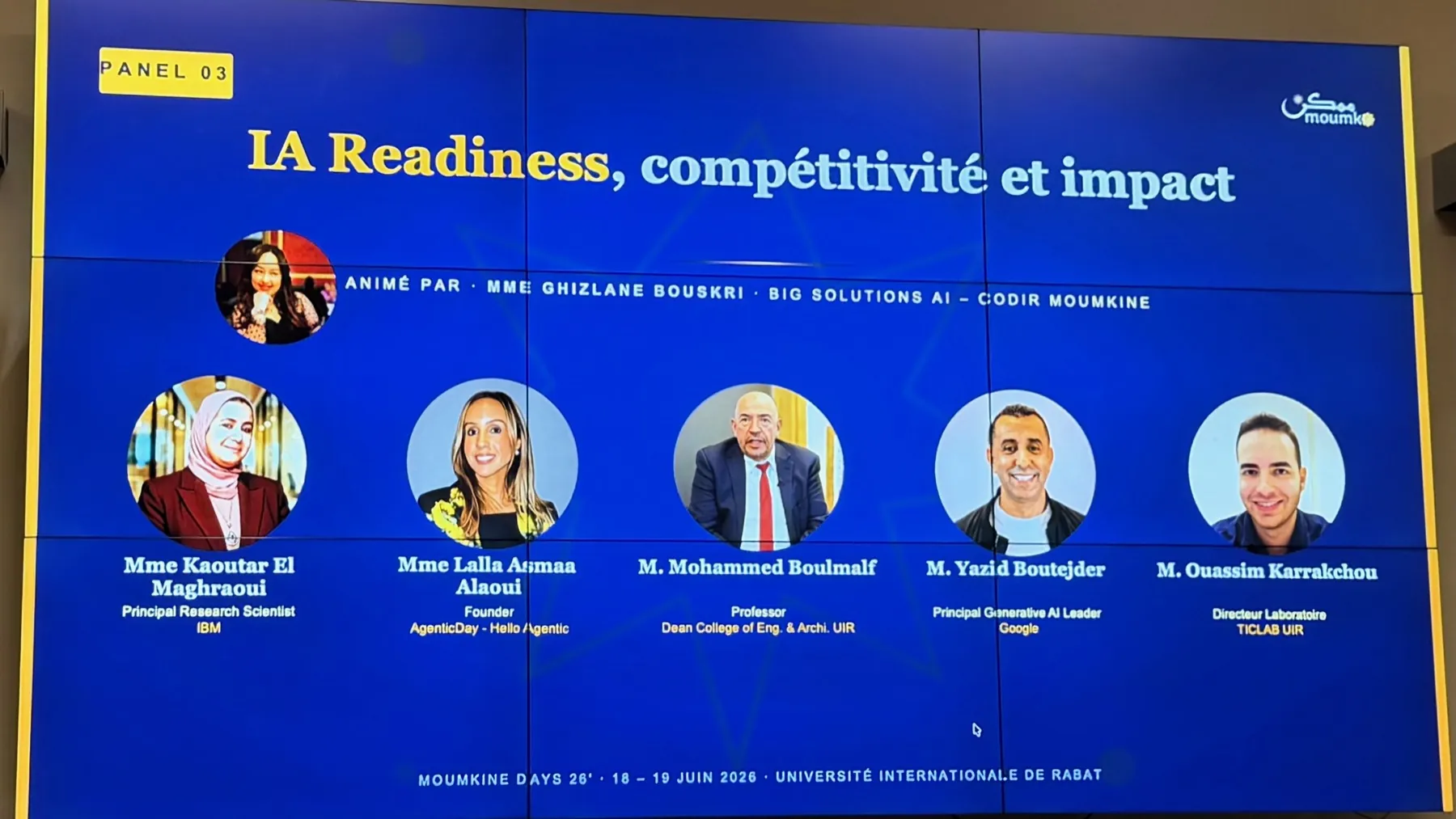 Panel 03: "IA Readiness, compétitivité et impact" at Moumkine Days, Université Internationale de Rabat. Moderated by Ghizlane Bouskri (BIG Solutions AI). Panelists: Kaoutar El Maghraoui (IBM), Lalla Asmaa Alaoui (AgenticDay / Hello Agentic), Mohammed Boulmalf (Dean, College of Eng. & Archi., UIR), Yazid Boutejder (Google), Ouassim Karrakchou (TICLAB UIR).
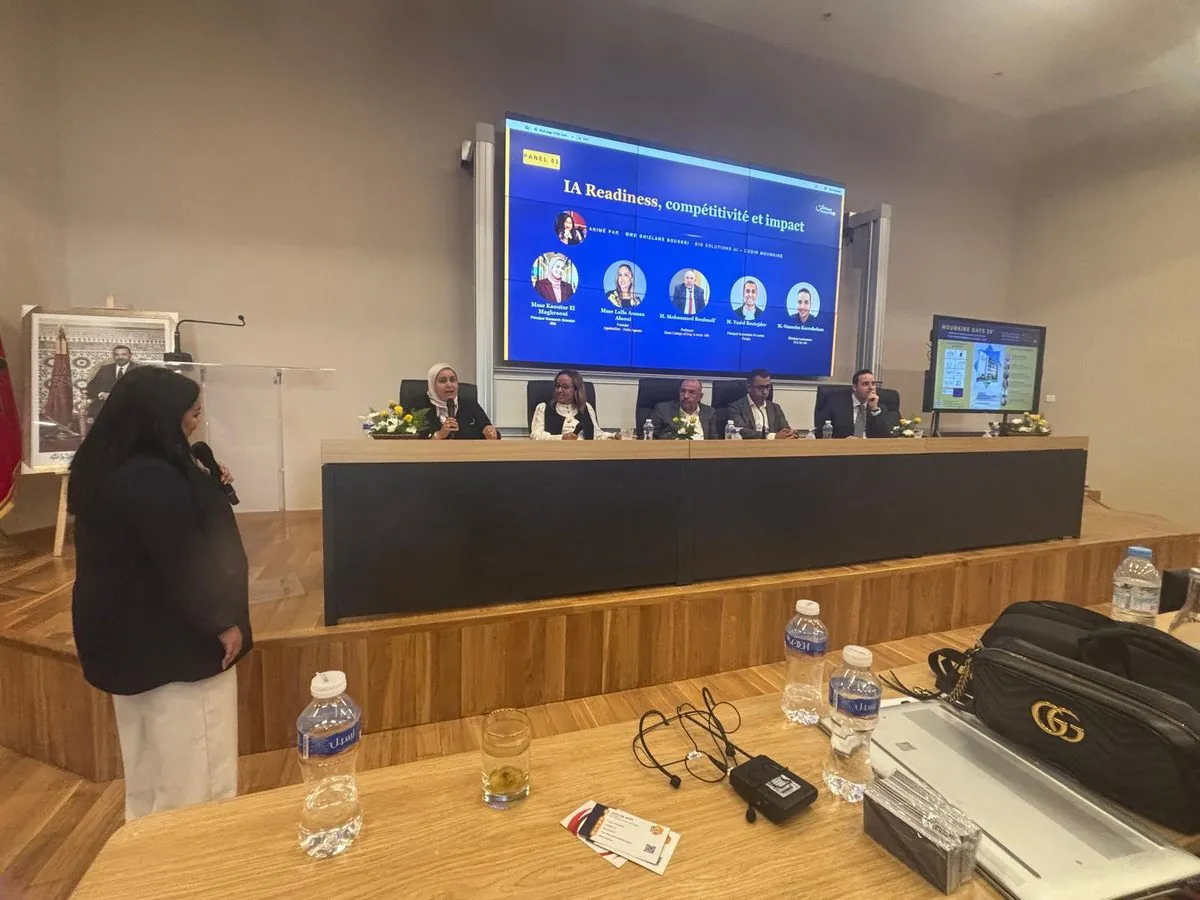 The panel live on stage at Moumkine Days, Université Internationale de Rabat.
Moumkine exists to reconnect Morocco with its people abroad, the ones who left and never stopped caring (program details). I am one of them. Being asked to come home and contribute is exactly the invitation a lot of us have been waiting for.
The infrastructure is real
Under Morocco's Digital Morocco 2030 strategy, launched under King Mohammed VI, AI now sits at the center of the national agenda. The numbers are substantial:
| $10B | 50,000 | 200,000 | ~2 GW |
|---|---|---|---|
| AI's targeted boost to GDP by 2030 | new AI jobs targeted | Moroccans to be trained in AI | data-center capacity announced |
Africa's most powerful supercomputer, Toubkal, is already running at UM6P [6]. A sovereign, renewable-powered 500 MW data center is going up in Dakhla [1]. A new digital partnership was signed with the European Union at GITEX Africa 2026 in Marrakech [6]. OCP, our phosphate giant, is using AI and satellites to help feed a continent [4]. Several of the ~2 GW data center pipeline projects were announced at GITEX Africa 2025 and 2026, which has become the continent's primary venue for AI infrastructure deals [2] [6].
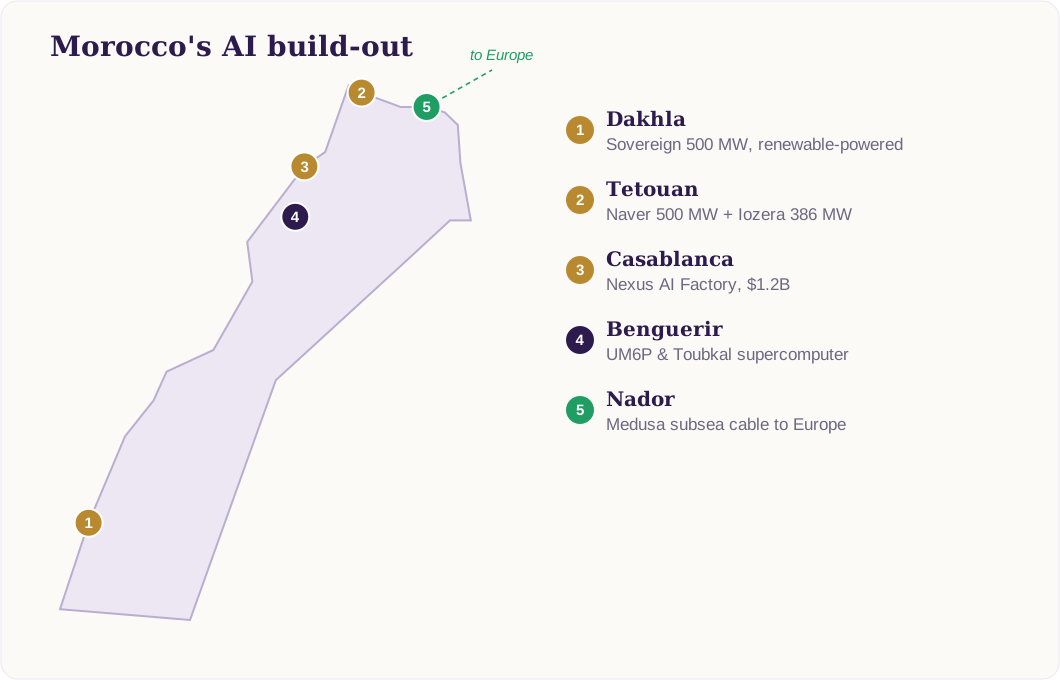 Fig 1: Morocco's AI build-out, from Dakhla to Tetouan: announced data centers, UM6P's Toubkal supercomputer, and the Medusa cable landing at Nador.
I did not fly to Rabat to tell anyone we are behind. I came to offer what the diaspora can add: a view from inside the global AI infrastructure industry and an honest read on where the harder work begins.
Sovereignty is a stack
Ask whether Morocco is "AI ready" and the honest answer is that we have moved fastest on the physical layer. That is a real achievement. But national AI capability has three layers:
- Infrastructure: silicon, power, connectivity. Morocco is securing this at speed.
- Data: the governance and pipelines that let hospitals, banks, and farms share data safely.
- Serving: where models actually run when they answer a question, ideally on our own soil, in Arabic, Darija, and Amazigh, under our own rules.
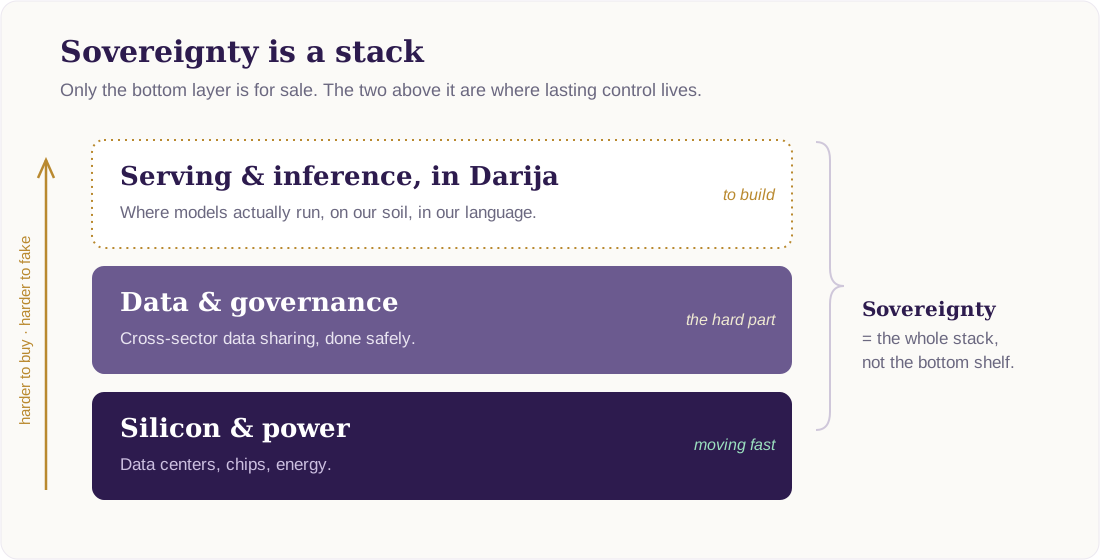 Fig 2: National AI sovereignty is a three-layer stack. Morocco has moved fastest on the layer that is easiest to buy.
Sovereignty is not only a data center. It is a stack, and the layers you cannot buy are the ones worth building.
Most of the two gigawatts Morocco has lined up is, sensibly, built as an export: nearshore compute for Europe. That is good business. The opportunity is to make sure a real share of it also serves Moroccans at home, so the same AI factories that earn export revenue also power our students, startups, and ministries.
Build small, solve big: the case for SLLMs
This is the recommendation I feel most strongly about. Morocco should not try to compete with the frontier LLM builders. OpenAI, Anthropic, Google, and a handful of others are spending tens of billions of dollars to train the largest models in the world. That is not our race.
Our race is building Small Language Models (SLLMs), models in the 1B to 8B parameter range, fine-tuned on Moroccan domain data to solve vertical problems in our own industries. A 3-billion-parameter model fine-tuned on OCP's agricultural data, or on Moroccan clinical records and patient interactions, or on automotive quality-control logs from Tangier's factories, can outperform a generic frontier model on those specific tasks. IBM demonstrated this with their Granite family of models: Granite 3B and 8B models match or exceed the performance of models 10 to 40 times their size on selected enterprise benchmarks including code generation, retrieval-augmented generation, and domain-specific reasoning [9]. These models run on hardware we already own.
The economics are decisive. Fine-tuning an open-weight model like Mistral (already a Morocco partner [1]), IBM Granite [9], or Llama on local industry data costs 100 to 1,000 times less than pretraining from scratch. Morocco's competitive advantage will not come from parameter count. It is domain data that no one else has: phosphate logistics, public health workflows in Darija and Amazigh, automotive telemetry from Africa's leading passenger car exporter.
These small models have a second advantage: they can be quantized to 4-bit precision and deployed at the edge, on devices in fields, on factory floors, in rural clinics where internet connectivity is unreliable. OCP already does satellite-plus-AI for precision farming. The next step is a model running on the farmer's own device, trained on local soil conditions, responding in Darija or Amazigh. No cloud round-trip required.
Invest in inference, not just in AI factories
Morocco should invest as much in inference optimization as it does in physical infrastructure. My own research at IBM focuses on exactly this problem: making AI models run faster and cheaper through quantization, mixed-precision computing, and hardware-aware compilation. The gains are real. Inference costs can drop 10 to 100 times through software alone, without buying a single additional GPU.
A national effort on inference efficiency means the same two gigawatts of installed capacity serve 10 times more Moroccans. It means a startup in Casablanca pays one-tenth what it would otherwise pay for each API call. It means the public compute commons I am about to propose becomes affordable.
The scale comparison
On stage I shared one number to keep us focused. Morocco's entire announced pipeline is around two gigawatts. A single American AI factory, Meta's Hyperion, is planned at five [3]. We are never going to win a gigawatt arms race against the hyperscalers, and our strategy already knows it. Our edge was never going to be the biggest AI factory. It is the smartest use of what only we have.
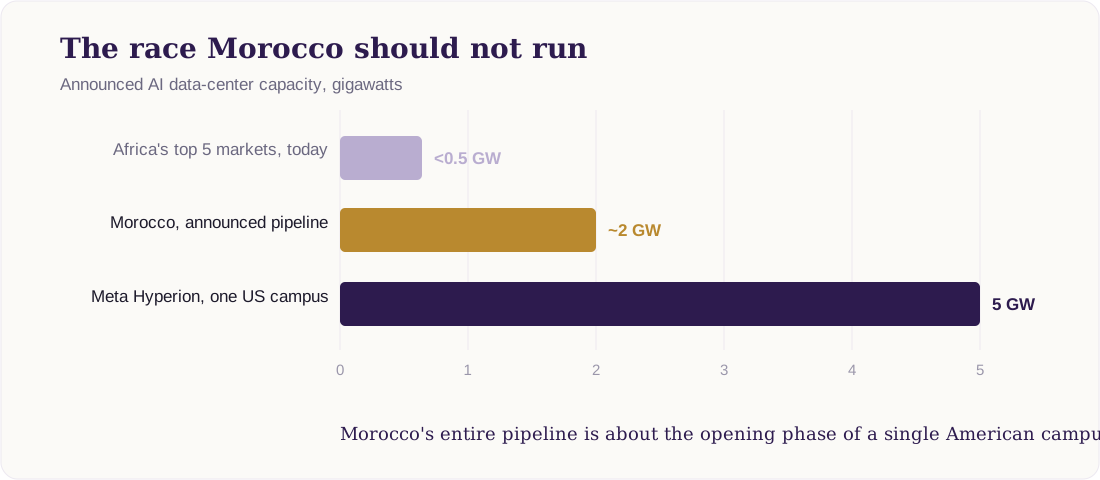 Fig 3: Announced AI data-center capacity. Sources: allAfrica / McKinsey [2]; IEEE Spectrum [3].
Globally, that two gigawatts is a small fraction of total announced capacity. But zoom into Africa and the picture is different.
#1 in Africa. Morocco already leads more than 60% of the continent's announced data-center pipeline, even while it sits mid-pack on operational capacity today. [8]
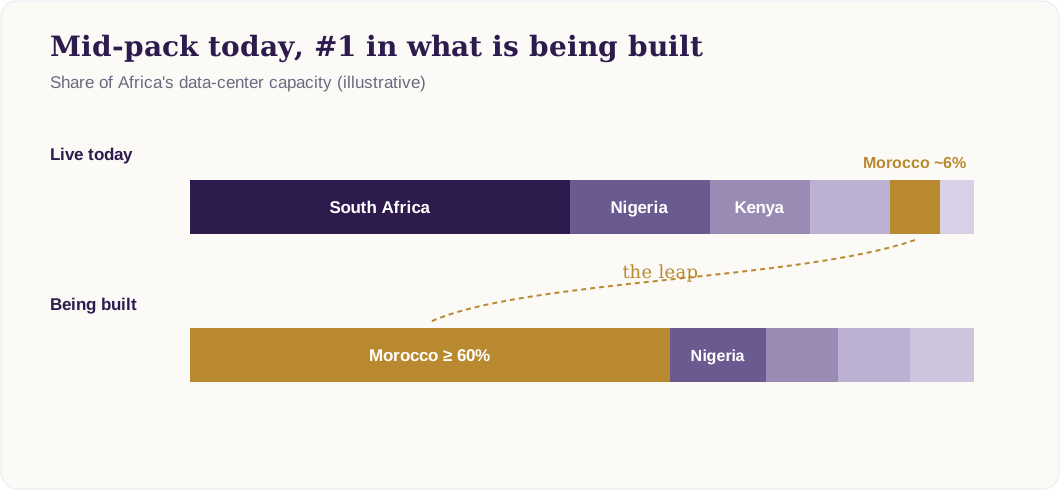 Fig 4: Where Morocco stands in Africa, today versus what is being built. Sources: industry data-center trackers [8]; allAfrica / McKinsey [2].
The energy and water challenges are real, and Morocco is already addressing them with renewable-powered campuses and, this winter, the end of a seven-year drought [7].
What only Morocco has
In one domain, Morocco already does this better than almost anyone.
We sit on the largest phosphate reserves on earth, the base of the fertilizer the whole planet's farms depend on. African farms grow about 1.7 tonnes of grain per hectare against a world average near 4.2, mostly because they use a fraction of the fertilizer [4]. Through OCP and its AgriEdge platform, Morocco is already pairing that phosphate with AI and satellite data to tell a farmer exactly what a field needs, cutting irrigation water by as much as a quarter and mapping tens of millions of hectares across Africa [4]. Nobody can replicate that, because nobody else controls these phosphate reserves. That is vertically integrated AI, built on Moroccan resources, with Moroccan data.
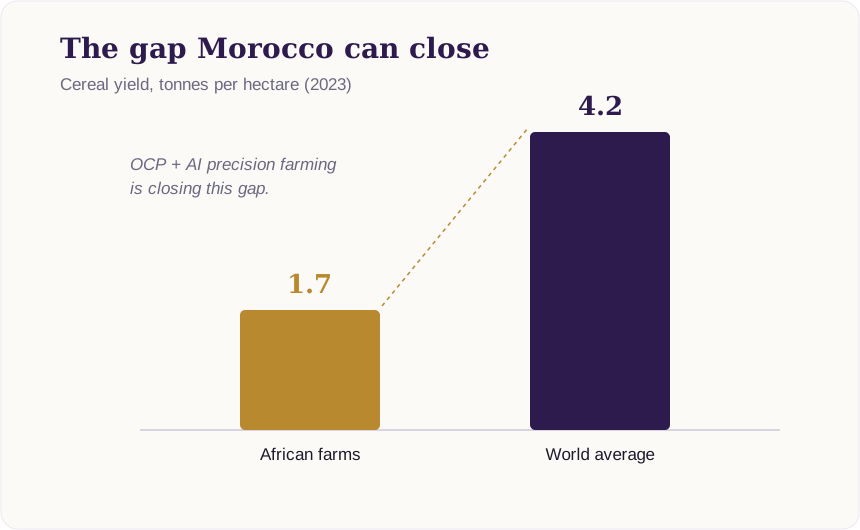 Fig 5: Africa's cereal-yield gap, the opening OCP's AI-guided fertilization is built to close. Source: African Business / FAO [4].
The same logic applies to our other strengths. We are Africa's leading passenger car exporter, so our industrial AI belongs on the assembly line. We are scaling solar capacity aggressively, enough to make AI infrastructure one of its highest-value uses. And we have Darija and Amazigh, languages no frontier lab will ever care about the way we do.
What is still missing
I would not be honest if I only listed strengths. Morocco still faces real gaps that need to be closed:
Open domain datasets are scarce. Most Moroccan industry data sits locked in private systems with no standardized formats. Agriculture, healthcare, and automotive all lack the open, high-quality training corpora that would let a hundred teams build SLLMs simultaneously. A national data commons initiative would solve this faster than any single company can.
AI startup density is low. Morocco has strong engineering talent but few AI-native startups generating revenue. The ecosystem needs more founders who have shipped ML products, not just researchers who have published papers. The diaspora can help here directly through mentorship and angel investment.
The GPU software ecosystem is thin. Training and fine-tuning requires not just hardware but CUDA expertise, compiler toolchains, and MLOps infrastructure. UM6P's Toubkal is a start, but Morocco needs more engineers who know how to use that compute efficiently.
All of these are solvable problems. None of them require the kind of capital that data centers do. They require coordination, open data policy, and the right people in the right seats.
Our greatest resource is our people
The talent pipeline is real: UM6P and its supercomputer, the free, no-diploma 1337 school, a generation of builders winning competitions abroad. We tend to talk about the ones who leave as a loss. Let me push back on that, as one of the people in question.
We are not gone. We are a national asset that happens to keep an office in New York, Paris, Zürich, and California.
The talent never stopped being Moroccan. What has been missing is a structured way to contribute back. A clean way to advise a startup in Casablanca, co-supervise a student in Rabat, or hold a small stake in something built at home without giving up the life we built abroad. And that is changing: the Moumkine forum, the new partnership with Europe [6], a startup ecosystem the state is actively funding [1]. Make the path easy and the brain drain turns into a distributed advantage.
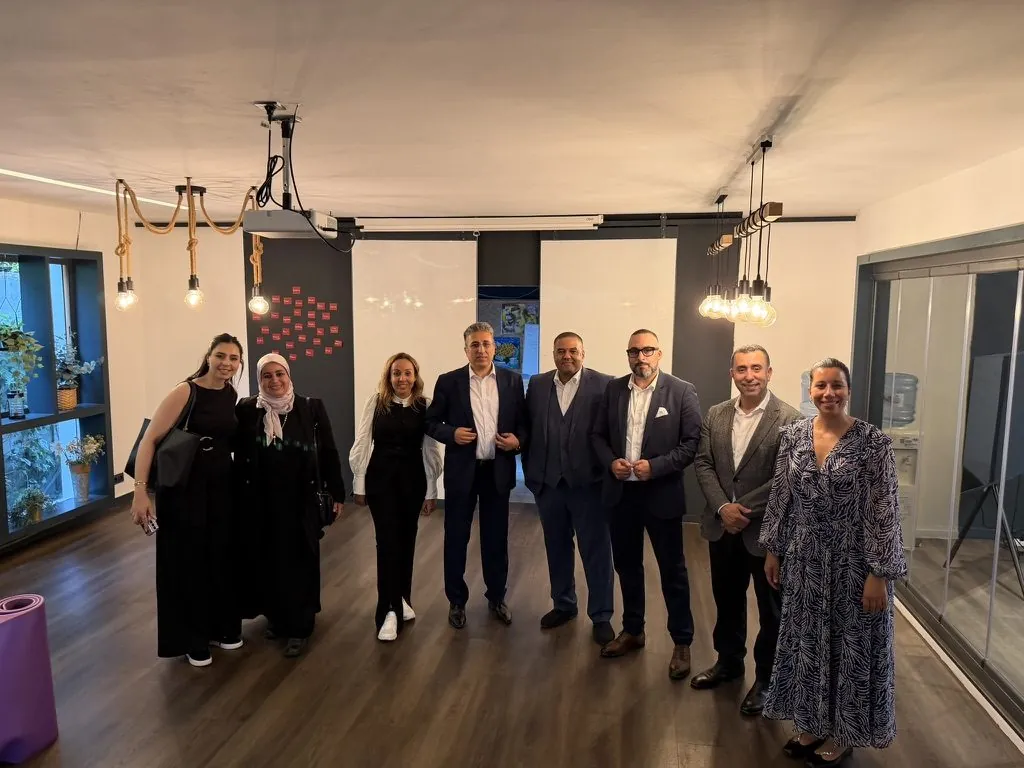 With other participants at Moumkine Days, Rabat.
Build it for everyone, in our own languages
One ambition I would prioritize.
"AI Made in Morocco" should mean AI that actually speaks Morocco. Today's tools perform well in English and poorly in Darija, Amazigh, and Hassaniya. The goal I would set is simple: make it work as well for a woman in Taza who speaks Tamazight as it does for an engineer in Rabat who works in French. Get that right and we will not just have closed a gap at home. We will have built something the rest of the Arabic-speaking and African world will want.
What I would love to see next
One panel settles nothing. But if I could add a few things to the national to-do list:
- Build Small Language Models for our vertical industries: agriculture, automotive, healthcare, finance, government services. Fine-tune open-weight models on our own data instead of training from scratch.
- Create a national open-data initiative to unlock domain-specific training corpora across key sectors.
- Reserve a real slice of our new capacity as a public commons: compute and shared data a student in Khouribga or a founder in Casablanca can use directly.
- Invest in inference optimization alongside infrastructure: quantization, mixed-precision, hardware-aware compilation can make the same hardware serve 10 times more users.
- Deploy AI at the edge for agriculture and industry, where connectivity is limited and the data is local.
- Give the diaspora a simple legal and tax path to own equity in Moroccan ventures without relocating.
- Turn the two years Europe just bought by delaying its own AI Act [5] into a head start, and make Morocco the clearest, best-governed place to build and test.
- Treat Darija, Amazigh, and Hassaniya as national AI infrastructure, not afterthoughts.
None of this asks us to out-spend anyone. It asks us to stay precise about what we are building and who it is for.
Why I will keep coming home
The organizers closed the forum with a slide that stayed with me. It read: "Le choix d'une génération," the choice of a generation.
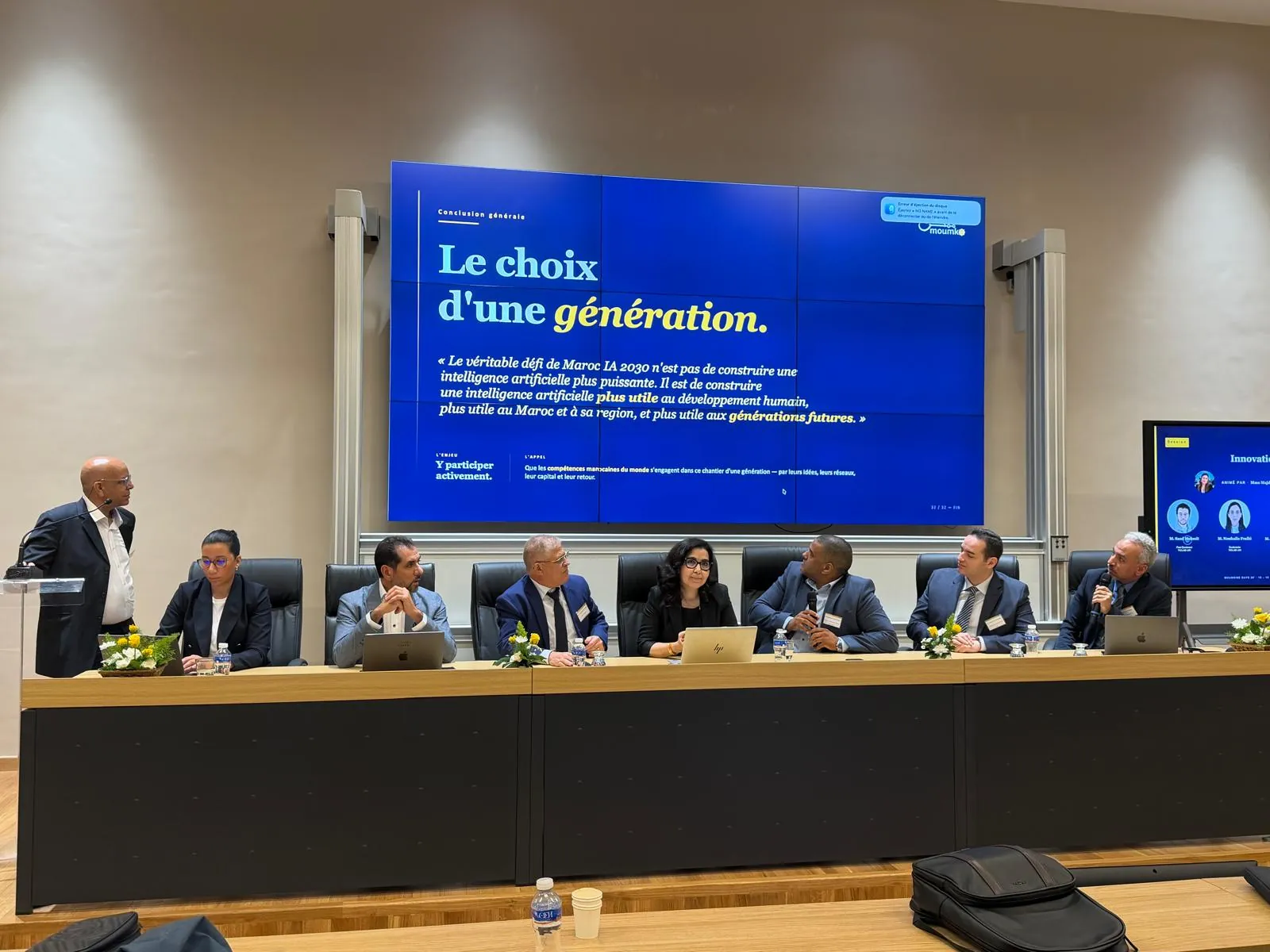 The closing session at Moumkine Days. The message on screen: "The real challenge of Morocco AI 2030 is not to build a more powerful artificial intelligence. It is to build an artificial intelligence more useful to human development, more useful to Morocco and its region, and more useful to future generations."
That framing is exactly right. The call to action beneath it was direct: that Moroccan talent worldwide commit to this project through their ideas, their knowledge, their capital, and their network.
Someone asked me afterward why I would use my personal vacation to cross an ocean for an hour-long panel. The panel was one hour, but I participated in the full two-day Moumkine Days program.
Morocco does not need to win the global model race. It needs to own the parts of AI that matter most to its people: the data, the serving layer, the models that speak our languages.
I left Morocco years ago. But Morocco never left me. I have not felt this certain in a long time that the country is building something the whole continent will study. I took vacation time to be at this panel, and I will keep doing what I can on my own time to help.
References
[1] Reuters / Middle East Online, January 2026. Under King Mohammed VI's Digital Morocco 2030 strategy, Morocco targets a ~$10B AI contribution to GDP by 2030, 50,000 AI jobs and 200,000 people trained, a ~$1.2B 2024-26 digital budget, a partnership with Mistral AI, a 500 MW renewable-powered sovereign data center in Dakhla, and a ~1.3B-dirham startup package toward 3,000 ventures by 2030. middle-east-online.com · Reuters via Yahoo Finance
[2] allAfrica / Dabafinance, January 2026; Global Data Center Hub, February 2026. Morocco's announced data-center pipeline approaches ~2 GW; operators describe much of the capacity as a nearshore export for European and Gulf clients. allafrica.com · globaldatacenterhub.com
[3] IEEE Spectrum, March 2026. Meta's Hyperion campus in Louisiana is planned at 5 GW (2 GW first phase by 2030), the largest single AI campus among its peers. spectrum.ieee.org
[4] African Business, July 2025. Through AgriEdge and OCP Nutricrops, OCP applies big data, AI and satellite imagery to precision agriculture across Africa, cutting irrigation water by ~25% and mapping 54M+ hectares. African cereal yields average ~1.7 t/ha against a ~4.24 global average (FAO). african.business
[5] Council of the EU, May 2026. The Digital Omnibus on AI defers the EU AI Act's high-risk obligations: stand-alone systems to 2 December 2027, and AI embedded in regulated products to 2 August 2028. consilium.europa.eu
[6] European Commission / European Interest, April 2026; African Business, April 2026. The EU-Morocco Digital Dialogue launched at GITEX Africa; four European supercomputing centers signed a letter of intent with UM6P, home to Africa's most powerful supercomputer, Toubkal. europeaninterest.eu · african.business
[7] Reuters, January 2026. Morocco declared the end of a seven-year drought following winter rains. Reuters via MarketScreener
[8] Industry data-center trackers (Arizton; Data Center Map), 2025-26. South Africa leads Africa's operational capacity; Morocco leads the announced pipeline. datacentermap.com
[9] IBM Research, 2024-2026. IBM Granite is a family of open-weight, enterprise-grade language models (1B to 30B parameters) trained for code, RAG, and domain-specific reasoning. Granite 3B and 8B models match or exceed the accuracy of models 10-40x their size on selected enterprise benchmarks while running on a single GPU. huggingface.co/ibm-granite · github.com/ibm-granite
Discussion
Sign in with GitHub to leave a comment or react. Threads are public and live in this site's GitHub Discussions.