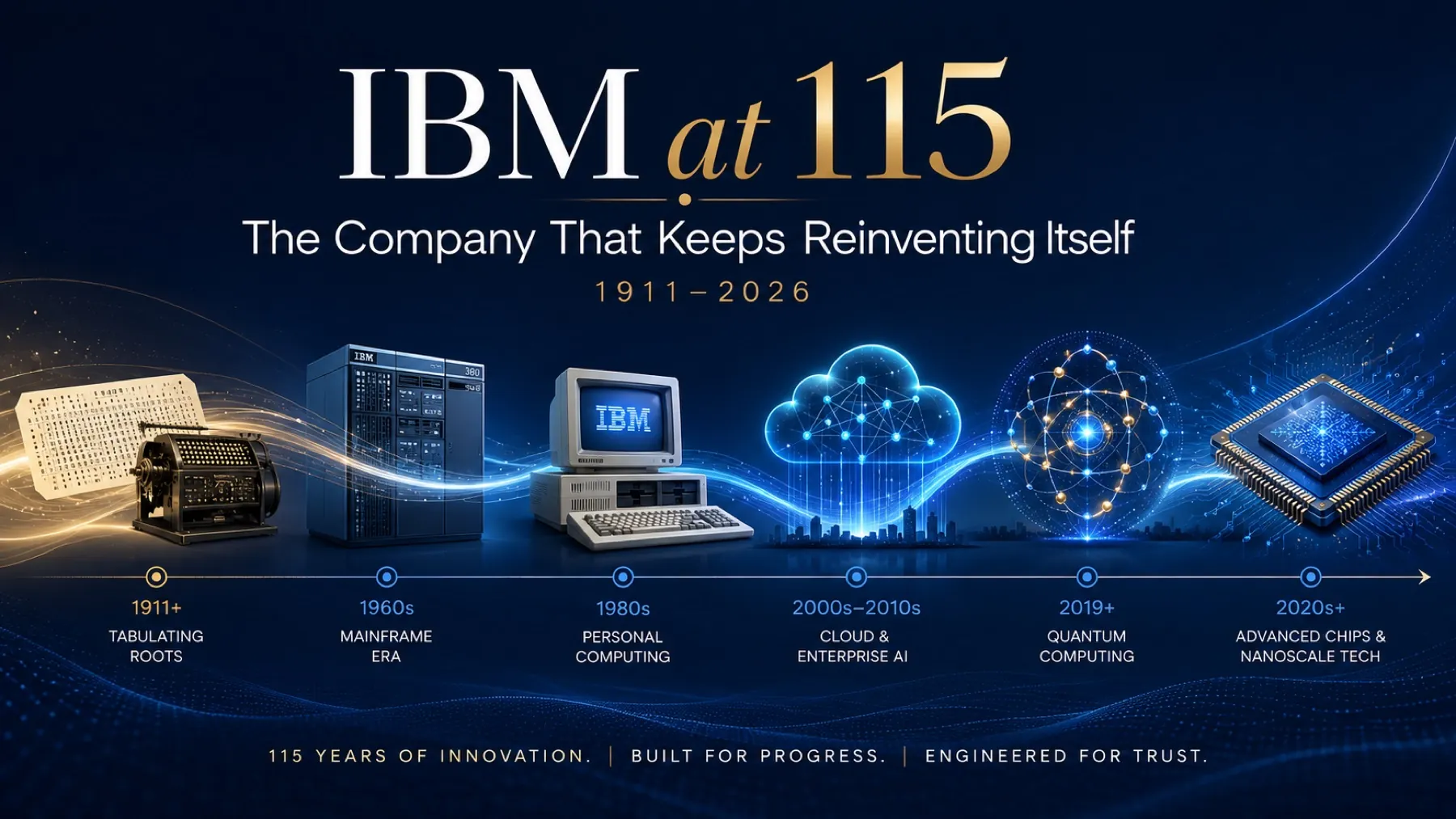
Most companies die by clinging to what once worked. IBM has lasted 115 years by repeatedly walking away from its own winners, sometimes early, sometimes only after a painful wake-up call, but more decisively than most institutions ever manage. That instinct, more than any single invention, is what is worth celebrating.
On June 16, 1911, a financier named Charles Flint stapled together four small companies that made grocery scales, time clocks, and punch-card tabulators, and called the result the Computing-Tabulating-Recording Company, or CTR [1]. There was not a single computer in the building. Thirteen years later, in 1924, the firm traded that clunky name for a grander one with no product baked into it at all: International Business Machines [1].
I have spent years inside this company as a researcher, and I have come to read that naming choice as a quiet statement of intent. A company called "Business Machines" never has to stay loyal to any one machine. That freedom became CTR's most valuable asset. Whatever it sold next, customers were really buying one thing that did not change: systems a serious institution could depend on.
This year IBM turns 115. I do not want to write the usual victory lap, the kind that lists old inventions one after another. I want to argue something sharper, as someone who builds AI systems here: IBM's real strength was never seeing the future more clearly than anyone else. It was the willingness to dismantle its own most profitable business, on purpose, at the moment most companies would have kept collecting the profits.
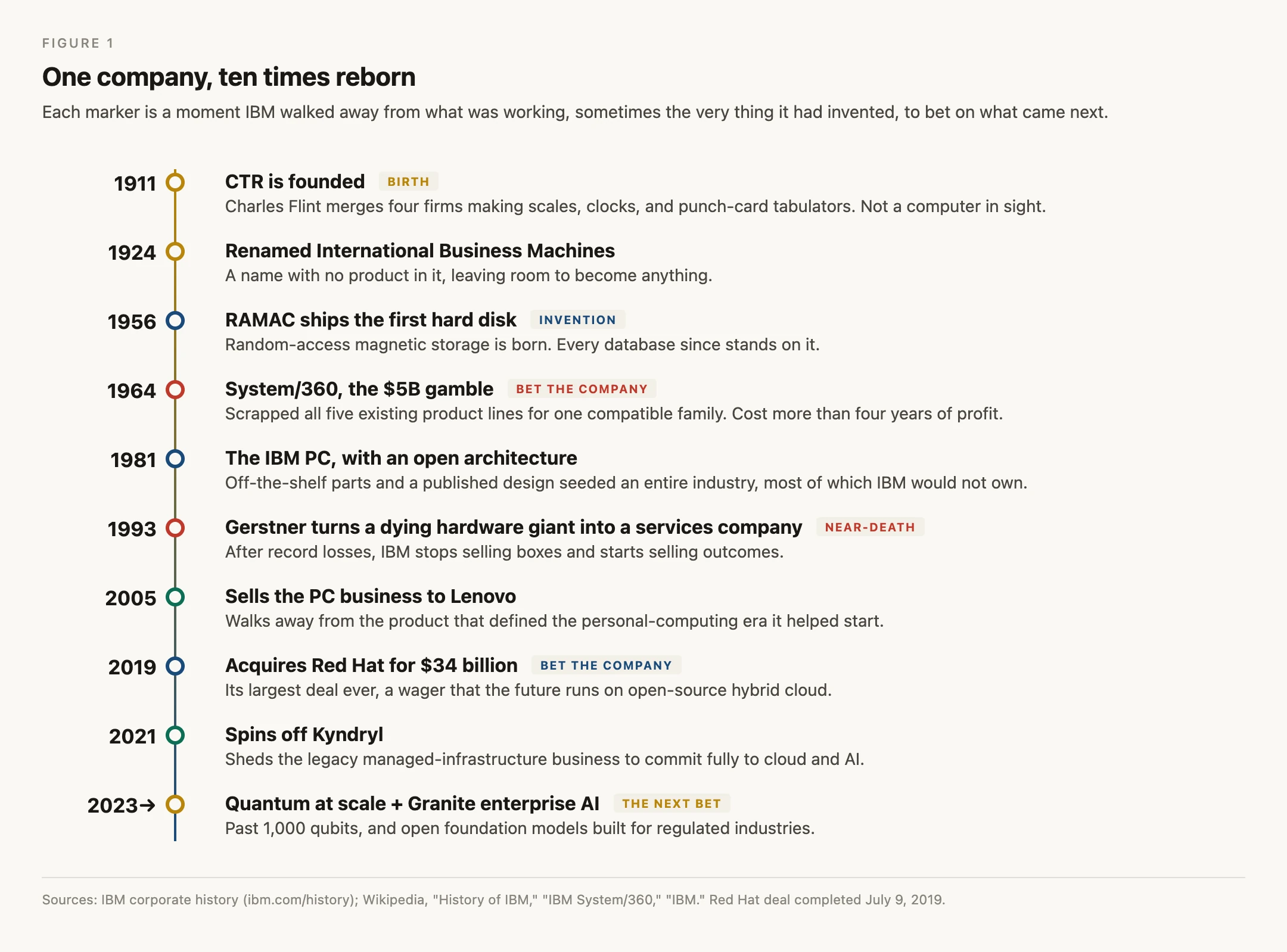 Fig. 1. Each marker is a point where IBM left a working business, sometimes one it had invented, to back what came next.
The $5 billion dare
The clearest example of this came in 1964.
By then IBM had five separate, incompatible computer product lines, all selling, all making money. Software written for one would not run on another. The sane move was to keep milking them. Instead, the company announced the System/360 on April 7, 1964: one family of mainframes, all software-compatible, all sharing peripherals, designed to replace every existing IBM computer at once [2].
IBM's own historians do not soften what this cost. The program ran roughly $5 billion over four years, more than the company earned in that stretch, and they still call it "the $5 billion gamble" [2]. Fortune at the time covered it as a gamble that could have destroyed IBM. It worked. The 360 set the template for how computers were sold for a generation, and the idea that software should outlive the hardware it runs on is now so obvious we forget someone had to risk a company to prove it.
The 360 was the clearest example. But IBM keeps making the same call: it looks at a business that still works and decides whether protecting it would make the next one impossible.
The foundations the whole industry runs on
Walk through almost any layer of modern computing and you will find an IBM invention holding it up.
The research labs have a long record of firsts. FORTRAN, the first high-level programming language anyone really used, came out of IBM in the late 1950s. Edgar Codd published the relational model of data in 1970 while at IBM, and that paper grew into the entire database industry [3]. The first commercial hard disk, RAMAC, shipped in 1956. The one-transistor dynamic random-access memory (DRAM) cell, the working memory in nearly every device you own, came from Robert Dennard at IBM. Reduced instruction set computing (RISC), the lean-instruction approach now inside your phone, traces back to John Cocke's work here. Two IBM physicists in Zurich won the 1986 Nobel Prize for the scanning tunneling microscope, which let humanity see and move single atoms, and two more won it the very next year, in 1987, for high-temperature superconductivity [4][5][6]. In 1997, Deep Blue became the first machine to beat a reigning world chess champion in a match under normal time controls [7].
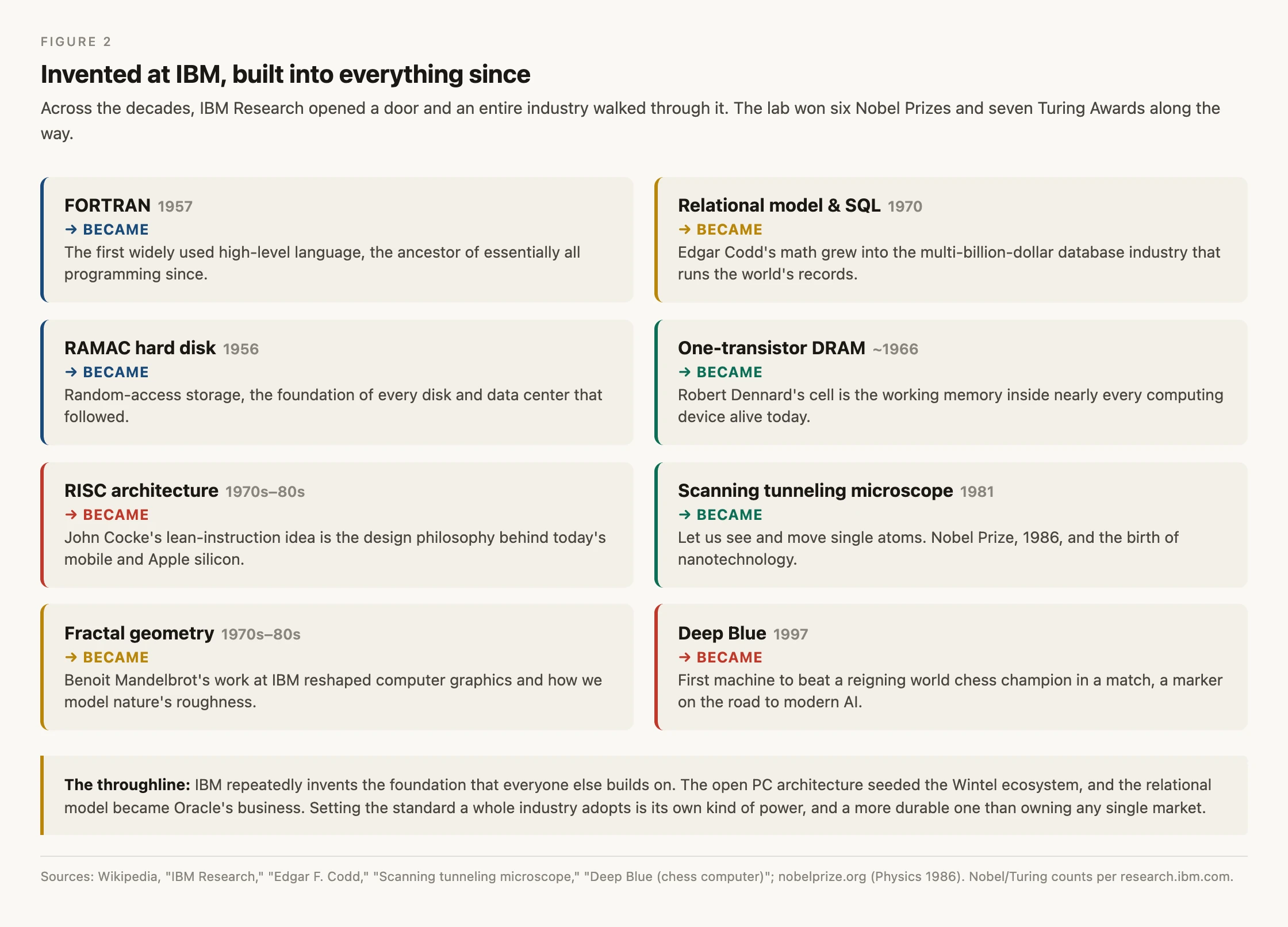 Fig. 2. Six Nobel Prizes and seven Turing Awards came out of this lab. Again and again, IBM created something and other companies built whole industries on it.
The 1981 IBM PC, released on August 12, was built from off-the-shelf parts and a published design [8]. That openness created the personal-computing industry. Relational databases became the foundation of Oracle's business, and the PC standard made Microsoft and Intel rich. IBM's ideas were never confined to IBM's own products. The company repeatedly set standards others adopted, a rare and durable exercise of power that outlasts any single product cycle.
That is the real measure of the place. A company that insists on owning everything it invents gets trapped by its own existing products. IBM's willingness to let other companies build industries on its ideas is the same strength that lets it leave its own products behind and build the next thing.
| IBM, by a few numbers | |
|---|---|
| Founded (as CTR) | June 16, 1911 |
| Renamed International Business Machines | February 14, 1924 |
| Nobel Prizes won by IBM researchers | 6 |
| Turing Awards | 7 |
| U.S. National Medals of Science | 5 |
| U.S. National Medals of Technology | 10 |
| Consecutive years atop the U.S. patent list | 29 (1993–2021) |
| U.S. patents granted (cumulative) | ~150,000+ |
Sources: IBM history and IBM Research [1][4][9]. The patent streak ended in 2022 when Samsung overtook IBM, so it is a finished record, not a running one.
The lab behind the firsts
Every prize in that table, and every invention above it, came out of one institution: IBM Research [4].
It began in 1945 as the Watson Scientific Computing Laboratory at Columbia University, which I have a soft spot for, since Columbia is where I teach now [15]. From that one room it grew into twelve laboratories on six continents: the Eero Saarinen-designed Thomas J. Watson Research Center in Yorktown Heights, the Zurich lab that won both of those physics Nobels, and labs in Almaden, Tokyo, Haifa, Nairobi, and Johannesburg. Today it is a community of around 3,000 researchers, and it states its mission in plain words: invent what's next in computing.
What makes the place unusual is not its size. It is that IBM has, for decades, paid researchers to chase questions with no product attached. Mandelbrot's fractals, the scanning tunneling microscope, high-temperature superconductivity: none of them were on a roadmap. They were curiosity, funded patiently, that paid off years or decades later. That is a strange thing for a public company to keep doing, and it is exactly the habit that produces the next foundation before the market knows it wants one.
A company can reinvent itself on schedule only if something inside it is already building the next thing while the current one still sells. For IBM, that something is IBM Research.
The near-death that taught the lesson
The reinvention story is easy to romanticize until you remember it nearly ended in the early 1990s.
The mainframe business that the 360 built became the thing IBM could not let go of, even as the world moved to cheap distributed machines. The company posted some of the largest losses in American corporate history. People expected it to be broken up and sold for parts. Lou Gerstner came in from outside, declined to split the company, and did something stranger than a breakup. He turned a firm that sold hardware into one that sold services and outcomes. It was the 360 logic applied to IBM itself: the business everyone wanted to protect had become the thing holding the company back.
That decade is why I trust the pattern instead of treating it as luck. A company gets to make the bold pivot look easy once. Doing it after you have already nearly died, when instinct says protect what is left, is a different kind of discipline.
The lesson of the 1990s was not "services are good." It was that the business you are most afraid to lose is usually the one you most need to let go of.
What IBM actually sells
IBM has never been a computer company, or a services company, or now an AI company. Underneath every reinvention it has sold the same thing: the dependable, verifiable systems that large institutions run their operations on. Call it infrastructure of trust. Punch cards counted the 1890 census and ran payrolls because they were auditable and standard. The 360 won because a bank could rely on that compatibility lasting. Relational databases won because the math was provably consistent. Services won because a regulated company wanted one accountable partner it could hold responsible. Hybrid cloud won the same way in the 2010s: IBM backed Linux and open source early, then paid $34 billion for Red Hat in 2019 so enterprises could run across clouds without giving up control [16].
Where the company goes next turns on this, and it is the part the systems researcher in me cares about most. The visible product changes every decade. What stays constant is the dependable system underneath, the one an institution can audit and trust with its most important records. IBM keeps replacing the visible product because that was never the real business.
My take, as someone building AI systems here
I work on hardware-software co-design, the unglamorous craft of making models and the chips they run on fit each other. IBM builds its own AI silicon, the Telum processors in its mainframes, the Spyre accelerator, the NorthPole and analog research chips, and none of it matters unless a real model runs well on it. When we map a model onto that hardware, the questions that decide whether it ships are rarely about peak accuracy. They are about whether the result is auditable and cheap enough that a regulated customer will run it on infrastructure they already trust. That is the hard part of enterprise AI, and it is the same problem IBM has been solving, in different forms, for 115 years.
Better qubits, quieter AI, smaller transistors
Three bets are on the table now.
The first is quantum. The numbers tell a story most coverage gets backwards. IBM crossed 1,121 physical qubits with its Condor chip in 2023, the largest of its kind, and then the per-chip count on its next processors went down, not up [10]. Heron and Nighthawk carry fewer qubits per chip than Condor did, but the strategy has shifted toward quality, connectivity, and scaling by linking modules together. The drop is deliberate, the same instinct as the 360: stop chasing the number that impresses people and start building the thing that actually works. The real goal is error-corrected logical qubits, and in June 2025 IBM put a date on it, committing publicly to Starling, a fault-tolerant machine running 100 million gates across roughly 200 logical qubits, built in Poughkeepsie by 2029 [11]. There is a nice symmetry here: IBM's most recent Turing Award, shared by its own Charles Bennett in 2025, honors the foundations of quantum information science, the very field IBM is now working to turn into a real machine [14].
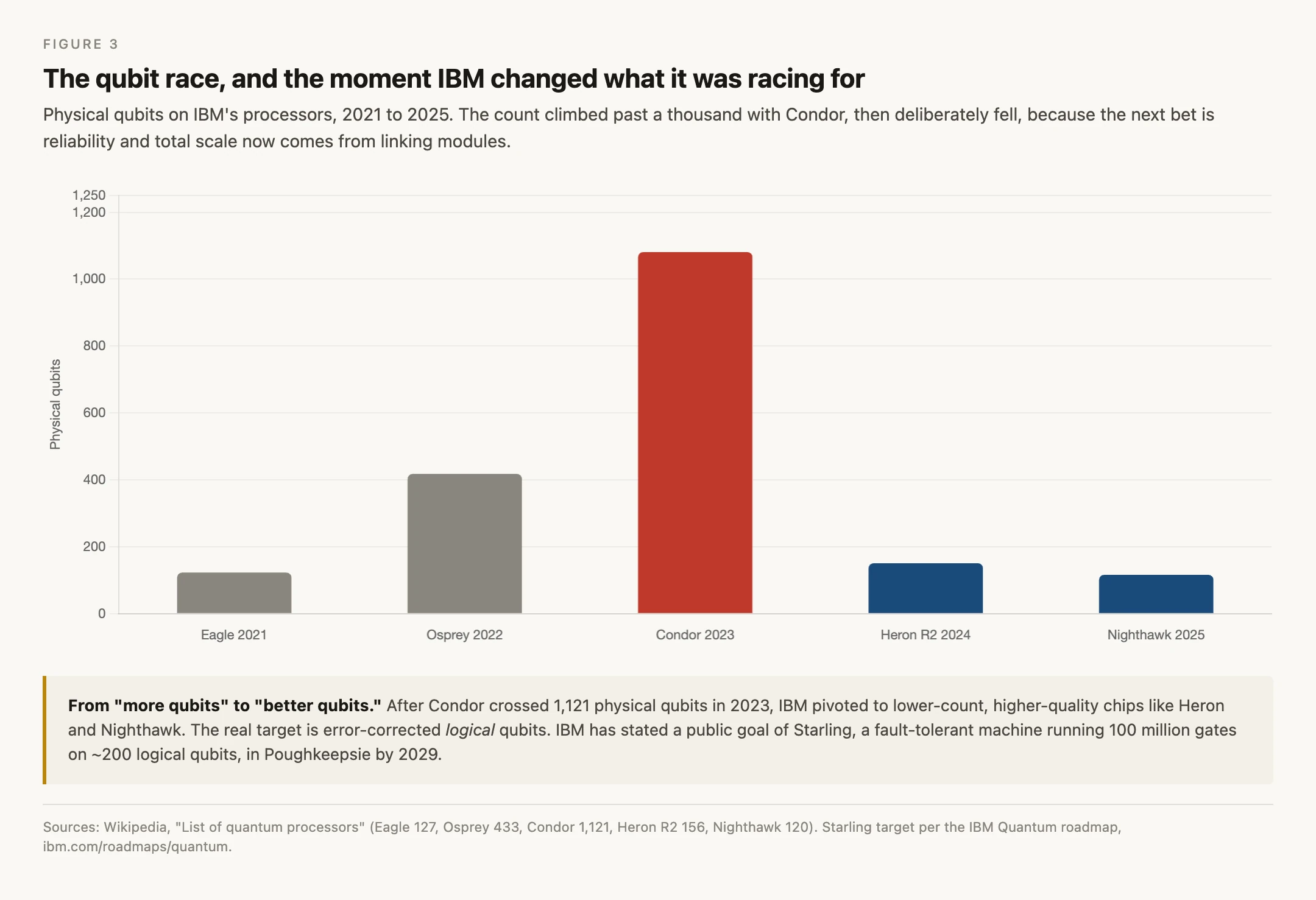 Fig. 3. The per-chip count climbed past a thousand, then fell on purpose. Reliability is the target now, and total scale comes from linking modules.
The second bet is enterprise AI, and it is quieter than anyone else's. Instead of chasing one giant consumer chatbot, IBM put out Granite, a family of open foundation models built for companies that need to know exactly what their AI was trained on and where it runs [12]. Boring and governable by design, it is the same trust-first strategy, this time aimed at AI.
The third bet is the most physical of the three. On June 25, 2026, IBM Research unveiled NanoStack, an architecture that stacks the two transistor types in a logic gate vertically, one above the other, instead of the side-by-side layout every chip designer grew up with [13]. IBM was first to the 2 nm nanosheet in 2021, and NanoStack stacks those nanosheet devices on top of each other to roughly double transistor density and reach the angstrom era, the first sub-1-nanometer node, with features about 0.7 nanometers across. The company projects chips 50% more powerful, or 70% more efficient, than its 2 nm node, the kind of gain that could cut training a large model from months to weeks.
None of the three is guaranteed. Quantum could stay a research curiosity for longer than the roadmap promises, open enterprise models face brutal competition, and a sub-1-nanometer transistor is still years from a production fab. What connects all three bets is the less flashy work underneath the hype: reliability, auditability, cost, and infrastructure that serious institutions can use.
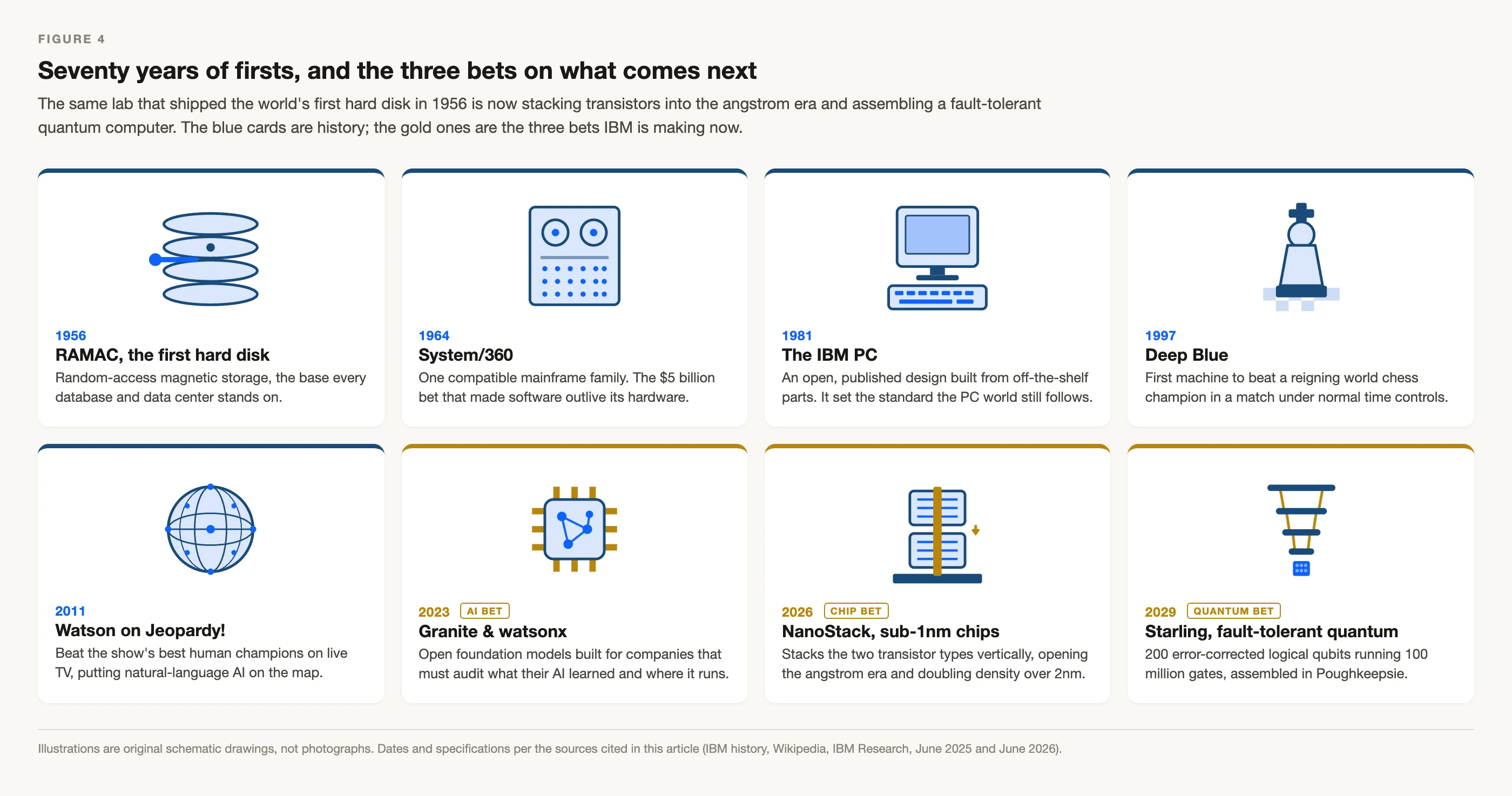 Fig. 4. The same lab that shipped the first hard disk in 1956 is now assembling a fault-tolerant quantum computer. From RAMAC to Starling, it is one long habit of inventing the next thing.
Why 115 is worth a candle
We tend to celebrate the companies that got something spectacularly right once. The harder, rarer thing is a company that has been willing to be wrong about itself, on schedule, for over a century, and to act on it. IBM has missed plenty of waves too. It was late to the minicomputer, late to the public cloud, and it learned several of these reinventions the hard way, through losses and layoffs rather than foresight.
IBM has left behind the tabulator, the room-sized mainframe as its whole identity, the PC it invented, and the services business that once saved it. Each time, the people inside had every reason to protect what was working, and each time the company chose the harder path of becoming something else. That habit is a skill, and one most institutions never learn.
At 115, the punch cards are in museums and the quantum machines are running in its labs. What connects them was never any particular machine. Happy birthday to the company that keeps reinventing itself, and somehow keeps being right.
References
[1] IBM, "IBM history," IBM corporate history. The Computing-Tabulating-Recording Company was founded June 16, 1911, and renamed International Business Machines on February 14, 1924.
[2] IBM, "System/360," IBM corporate history. The System/360 was announced April 7, 1964, and described by IBM as a "$5 billion gamble" that replaced all existing IBM computer products.
[3] IBM, "The relational database," IBM corporate history. Edgar F. Codd published the relational model of data in 1970 while at IBM Research.
[4] IBM Research, "About IBM Research," accessed 2026. Home of foundational inventions such as FORTRAN, RAMAC, DRAM, RISC, and the scanning tunneling microscope, and recipient of six Nobel Prizes, seven Turing Awards, ten U.S. National Medals of Technology, and five National Medals of Science.
[5] The Nobel Prize, "The Nobel Prize in Physics 1986," awarded in part to Gerd Binnig and Heinrich Rohrer (IBM Zurich) for the scanning tunneling microscope.
[6] The Nobel Prize, "The Nobel Prize in Physics 1987," awarded to J. Georg Bednorz and K. Alexander Müller (IBM Zurich) for high-temperature superconductivity.
[7] IBM, "Deep Blue," IBM corporate history. Deep Blue defeated reigning world chess champion Garry Kasparov 3.5–2.5 in May 1997.
[8] IBM, "The IBM Personal Computer," IBM corporate history. The model 5150 was released August 12, 1981.
[9] Wikipedia, "IBM," accessed 2026, for the U.S. patent record: 29 consecutive years (1993–2021) atop the list, a streak that ended when Samsung overtook IBM in 2022.
[10] Wikipedia, "List of quantum processors," accessed 2026. IBM Eagle (127), Osprey (433), Condor (1,121), Heron R2 (156), Nighthawk (120).
[11] IBM Quantum, "IBM Quantum roadmap," accessed 2026. IBM Quantum Starling is targeted for 2029 in Poughkeepsie, NY, with roughly 200 logical qubits running 100 million gates.
[12] IBM, "IBM Granite," accessed 2026. A family of open foundation models from IBM Research built for enterprise use.
[13] IBM Research, "Introducing the first sub-1 nanometer node chip," June 25, 2026. The NanoStack architecture stacks nFET and pFET vertically, projecting roughly double the transistor density of IBM's 2 nm node.
[14] IBM, "IBM's Charles Bennett receives the 2025 ACM Turing Award," 2026. Bennett, an IBM Fellow, shared the award with Gilles Brassard for the foundations of quantum information science.
[15] IBM Research, "IBM Research history," accessed 2026. Founded in 1945 as the Watson Scientific Computing Laboratory at Columbia University; headquartered at the Thomas J. Watson Research Center in Yorktown Heights, New York.
[16] Red Hat, "IBM Closes Landmark Acquisition of Red Hat for $34 Billion, Defines Open, Hybrid Cloud Future," July 9, 2019.
Discussion
Sign in with GitHub to leave a comment or react. Threads are public and live in this site's GitHub Discussions.