The Brilliant Bros at DI Global Finals 2026: A Mom's View From the Stands
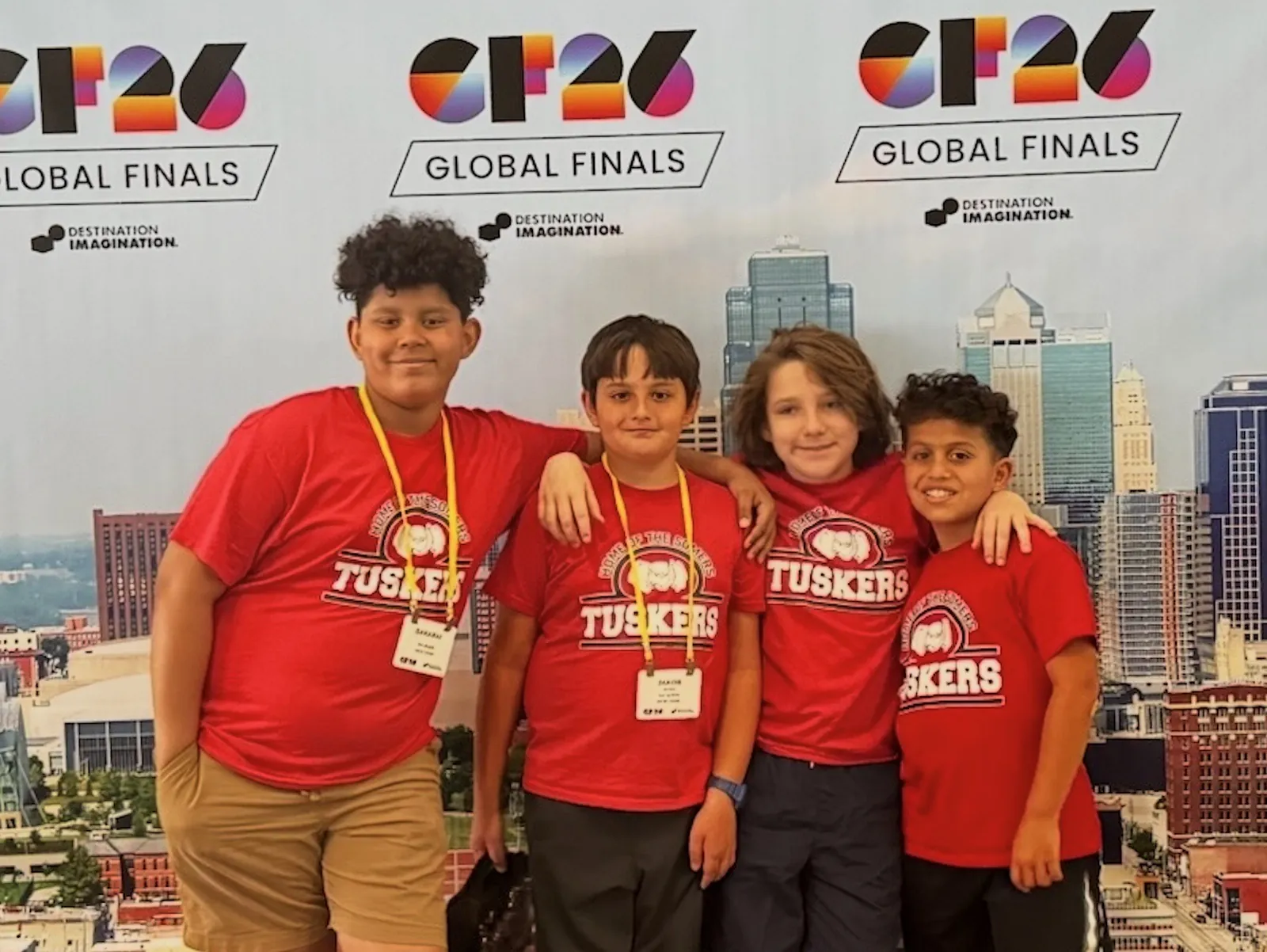
I want to document the journey of my son Adam and his teammates from the start of their Destination Imagination season to the Global Finals stage in Kansas City. Eight months of work, split between a community build space and the kids' own homes. Seven kids in total, four of whom flew to Missouri and finished 10th in the world.
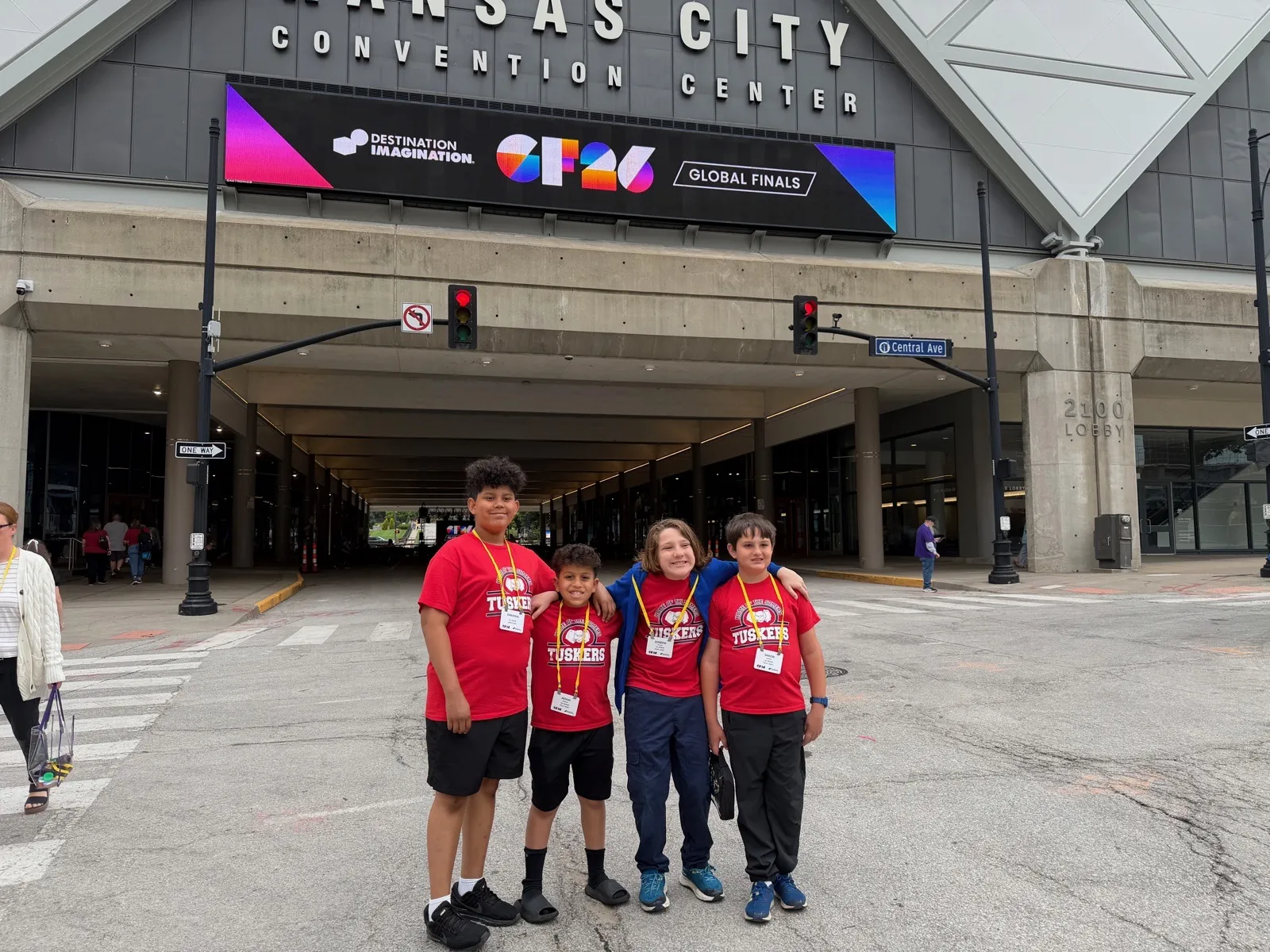 The Brilliant Bros at Global Finals: Adam Cherif, Dakarai Lacey, Jakob Kelly, and Joey McKenna outside the Kansas City Convention Center the morning of their performance.
How the team came together
The story of Brilliant Bros did not start with four kids. It started with five.
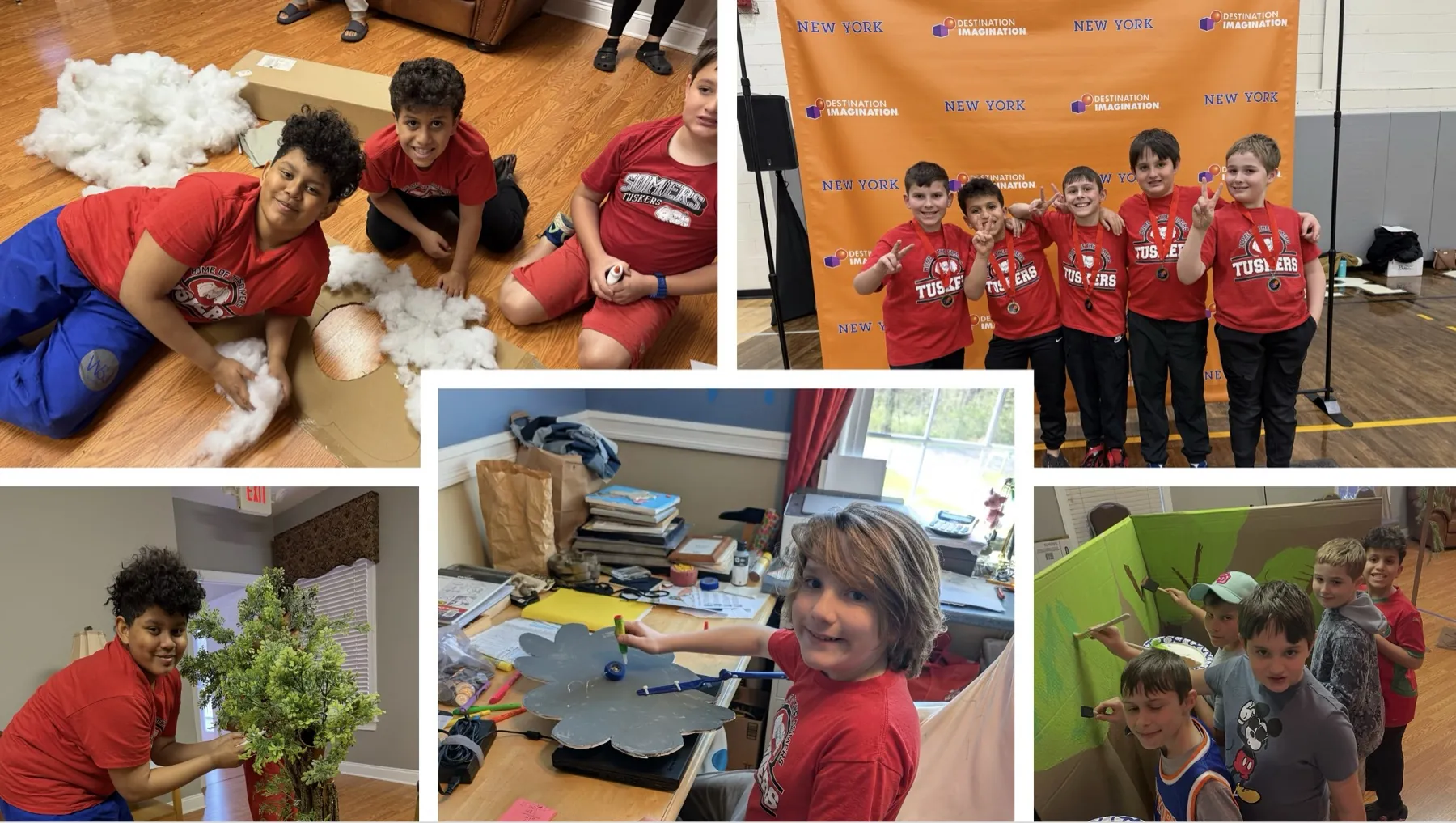 The Brilliant Bros across the season: build days, rehearsals, the road through New York, and Globals. Seven kids in total, four on the Globals stage.
Last fall, Adam joined a Destination Imagination team at Somers Intermediate School with four other boys from the same school: Jakob Kelly, Eddie Herald, James Oldis, and Brendan Mallamud. They picked the Scientific Challenge, Unforgettable, and spent the fall and winter writing the play, sketching the cave, gluing bark to cardboard tree trunks, and designing an antique-looking mystery map with invisible ink that only shows up under black light. Eddie was the original main character. James and Brendan were the supporting cast. The team manager was Kerry Kelly, who the kids called Coach Kelly. She ran the meetings, kept the build space stocked, learned the rule book inside out, and handled all the tournament logistics. She also held the line on Interference, which is the part most parents would have failed at. None of this happens without her.
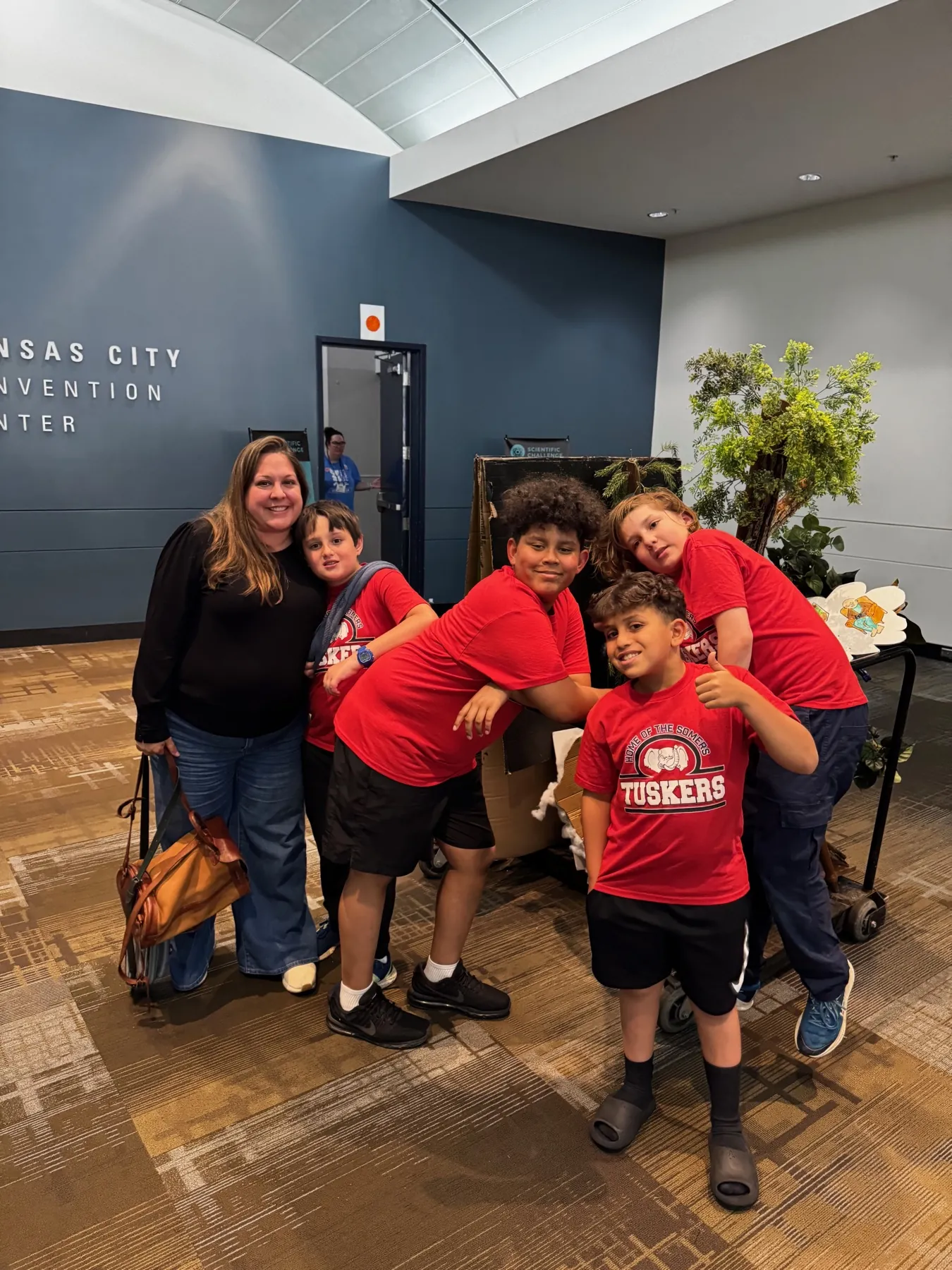 The Brilliant Bros with Coach Kerry Kelly. Eight months of Fridays, Saturdays, and Sundays, a stack of rule-book annotations, and a manager who knew when to step back. By February they had a script, a forest, and a cave that mostly stood up. In March they took it to the Eastern New York regional tournament and qualified for the New York State Affiliate tournament. At States, they finished 2nd in the state in the Scientific Challenge with 362.19 points, which earned them the invitation to Global Finals [5].
Then real life happened. Three of the original five (Eddie, James, and Brendan) could not make the trip to Kansas City. Schedule conflicts and family travel, the usual collisions of an eight-month season ending in late May. The team was suddenly down to two: Adam and Jakob. Globals registration was less than two months away.
So the team grew. Two new boys, Dakarai Lacey and Joey McKenna, joined the lineup. Dakarai took the main character role, the part Eddie had built. Joey took on the narrator and on-stage scientist, the voice that explains the memory science to the audience. They learned the eight-minute script, the blocking, the prop choreography, and the Instant Challenge drills in about six weeks. They reshaped the parts as they took them on. Dakarai and Joey helped sharpen the script, layered in more lighting effects and props to make the memory and reveal scenes pop, and blended into the existing chemistry as if they had been on the team since September. The expanded roster ended at four: Adam, Jakob, Dakarai, and Joey. That was the team that flew to Kansas City and stood on the Globals stage.
The team's own poster captures it best. Under "Meet the Brilliant Bros" they printed two cast lists side by side: the Eastern Tournament Team on the left, the Global Finals Team on the right, with one line between them: "It took all 7 of us to reach the Global Finals." That line is the team. You can see the full team poster here.
Eddie, James, and Brendan got them to states. Dakarai and Joey got them to Globals. Adam and Jakob carried the thread between them.
What Destination Imagination actually is
If you have never heard of Destination Imagination, neither had I until Adam came home from school last September with a flyer and a question: can I do this?
DI is a global creative-problem-solving program for kids in kindergarten through university. Teams of up to seven pick one of seven Team Challenges each season and spend the year designing a solution. The catch is that the solution has to be entirely the kids' work. Parents, coaches, teachers, none of us are allowed to give them ideas, suggest fixes, or touch the props. The rule is called Interference, and the appraisers really do enforce it [1].
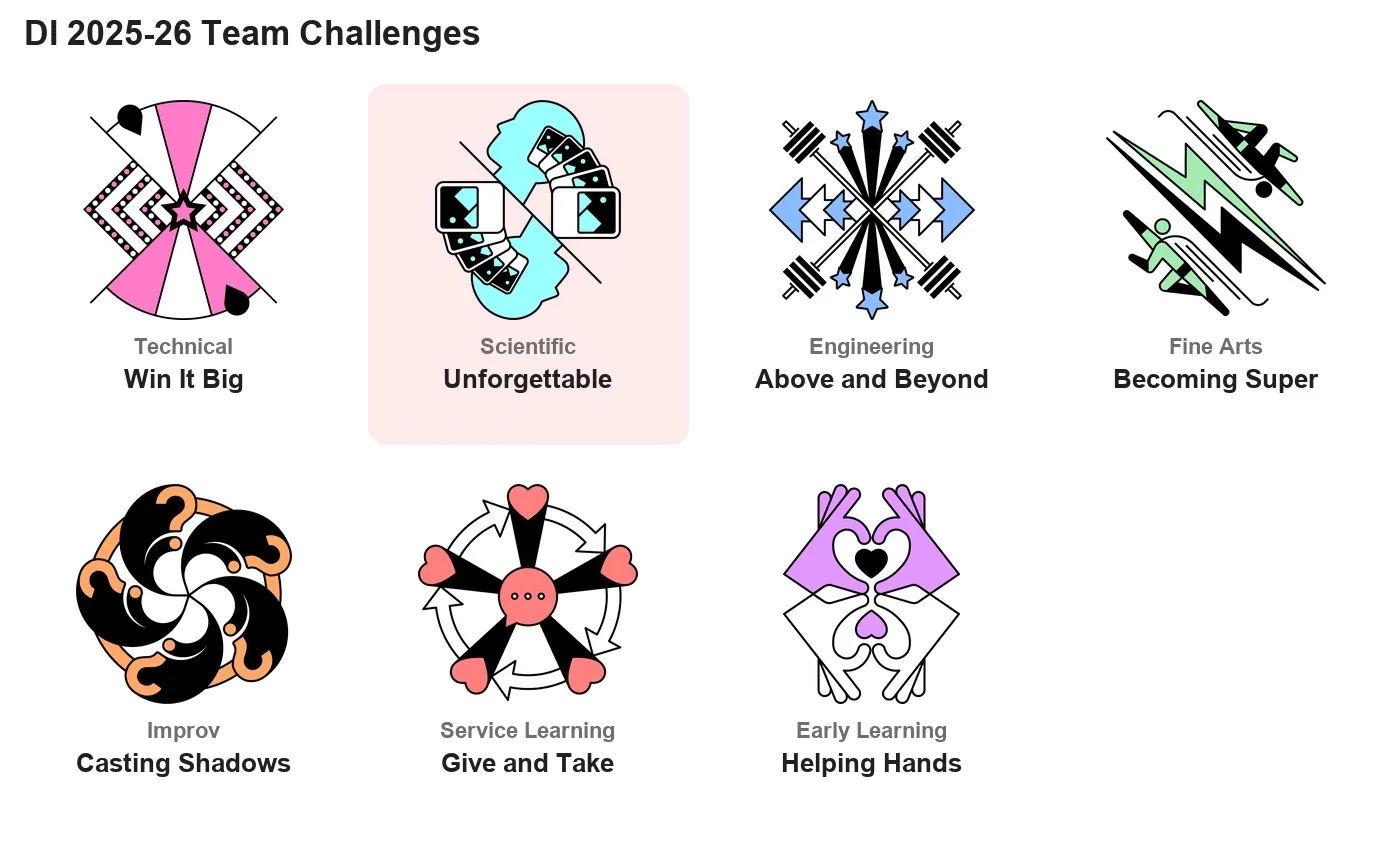 The seven challenges DI offered teams this season. Brilliant Bros chose Scientific (Unforgettable). Each challenge has its own rules, scoring rubric, and required elements. Icons via destinationimagination.org.
The season ends with a tournament ladder: Regional, then state (which DI calls Affiliate), then Global Finals. Global Finals 2026 ran May 21–24 in Kansas City. DI's official kickoff announcement put the operational scope at 10,000 people, more than 600 teams, and 11 countries [9]. The teams came from the United States, Mexico, Guatemala, Canada (Quebec), Ukraine, China, South Korea, Poland, Australia, Turkey, and the Netherlands. It is the largest event of its kind on the planet [2].
Every team's score has two parts. The Team Challenge is the long project they have been working on all year. The Instant Challenge is something else: a sealed problem they walk into a room and solve in five to eight minutes, with materials they have never seen, in front of appraisers they have never met. The Instant Challenge is worth a quarter of the final score, and you cannot prepare for the specific problem. You can only prepare for the kind of pressure it creates.
The Brilliant Bros chose the Scientific Challenge, Unforgettable [3]. The challenge asked teams to build a story around a memory that leads to a realization, integrate real research about how human memory works, and pull off a special effect and a piece of theatrical misdirection on stage.
The story they wrote
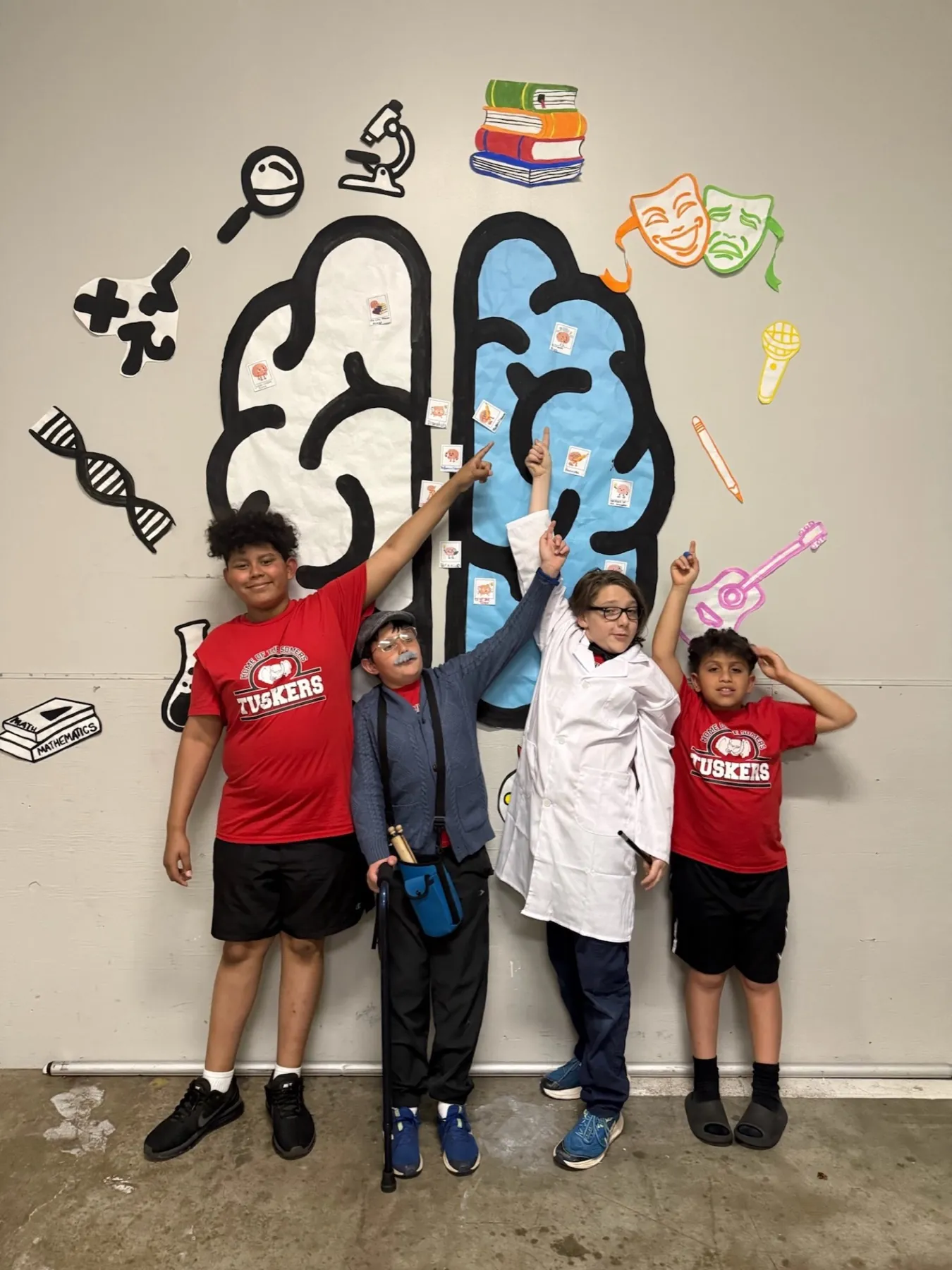 In costume in front of the giant brain installation on the convention center floor. A fitting backdrop for a team whose challenge was about how the brain remembers and forgets.
The Globals lineup divided up the play like this. Dakarai played the main character, also named Dakarai, the boy who inherits the treasure map. Jakob played Jake, the leader and best friend, and doubled as Grandpa in the opening memory scene. Joey played the narrator and on-stage scientist who breaks the fourth wall to teach the audience about memory. Adam played the mischievous friend, also named Adam, who is afraid of the dark and uses theatrical misdirection to keep everyone away from a hidden cave.
The plot, in eight minutes: Dakarai's grandfather gives him an old family map and shows him that it only reveals its secret trail under UV light. Years later, Dakarai gets hit in the head during a backyard football game and forgets how to read the map. He and his friends wander the woods. Adam's character secretly steers them in circles to avoid the cave. The memory only comes back when Jake peels an orange and the smell pulls Dakarai back into the porch scene with his grandfather. They find the cave. The back wall, lit by a UV flashlight, glows with the words FRIENDS FOREVER. The treasure is the friendship.
The science is real. The smell-triggers-memory mechanism is called the Proust effect, after the famous madeleine passage in In Search of Lost Time, and there is genuine evidence that olfactory cues reach autobiographical memory faster and more emotionally than visual or verbal cues [4]. The boys read about it, talked about it, and wrote it into the script. Joey, as the on-stage narrator, explains it directly to the audience mid-scene. That part of the challenge stayed with me as a scientist. They were teaching the science as they performed it.
Building the world
This is the part I watched up close, because pieces of the build lived in our home for months alongside the team's community build space. The team met on Friday afternoons, Saturdays, and Sundays, sometimes more than once a day. Many of those sessions were rehearsals and building, and many were Instant Challenge practice runs against the clock.
The cave stands roughly six feet tall. The boys built it from cardboard, sheets of Styrofoam, hot glue, paint, and glow-in-the-dark paint. The interior is coated so that under UV light the back wall lights up with the FRIENDS FOREVER message and a trail of glowing arrows. The exterior is painted to look like rock, and the whole thing hides behind cardboard flaps that the boys painted to match the surrounding forest. From the audience you cannot see the cave at all until they pull the flaps back.
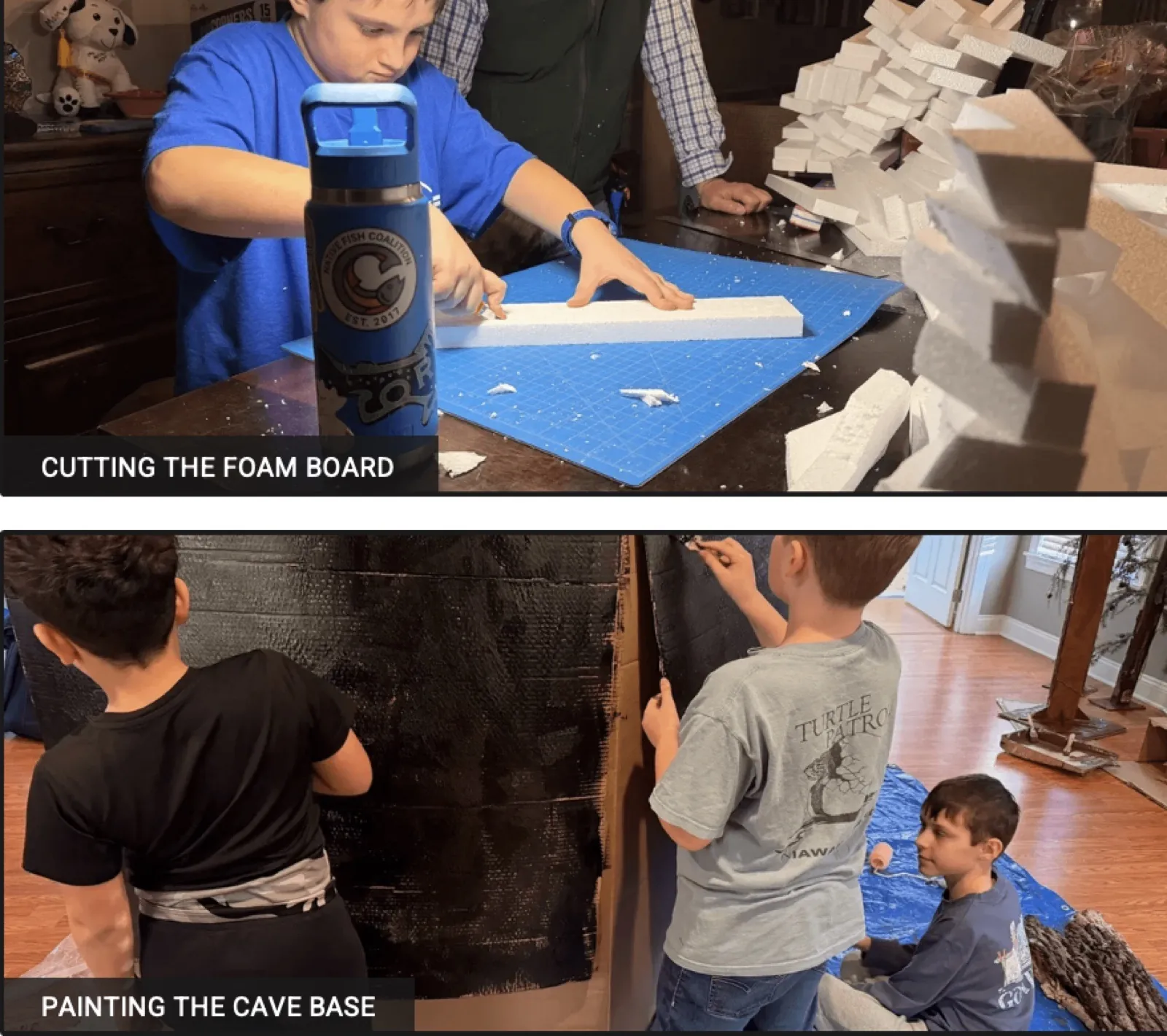 The early build: cutting foam board to size for the rock face on top, painting the cave base on the bottom. Slow, messy work that the kids did themselves over a long string of weekends.
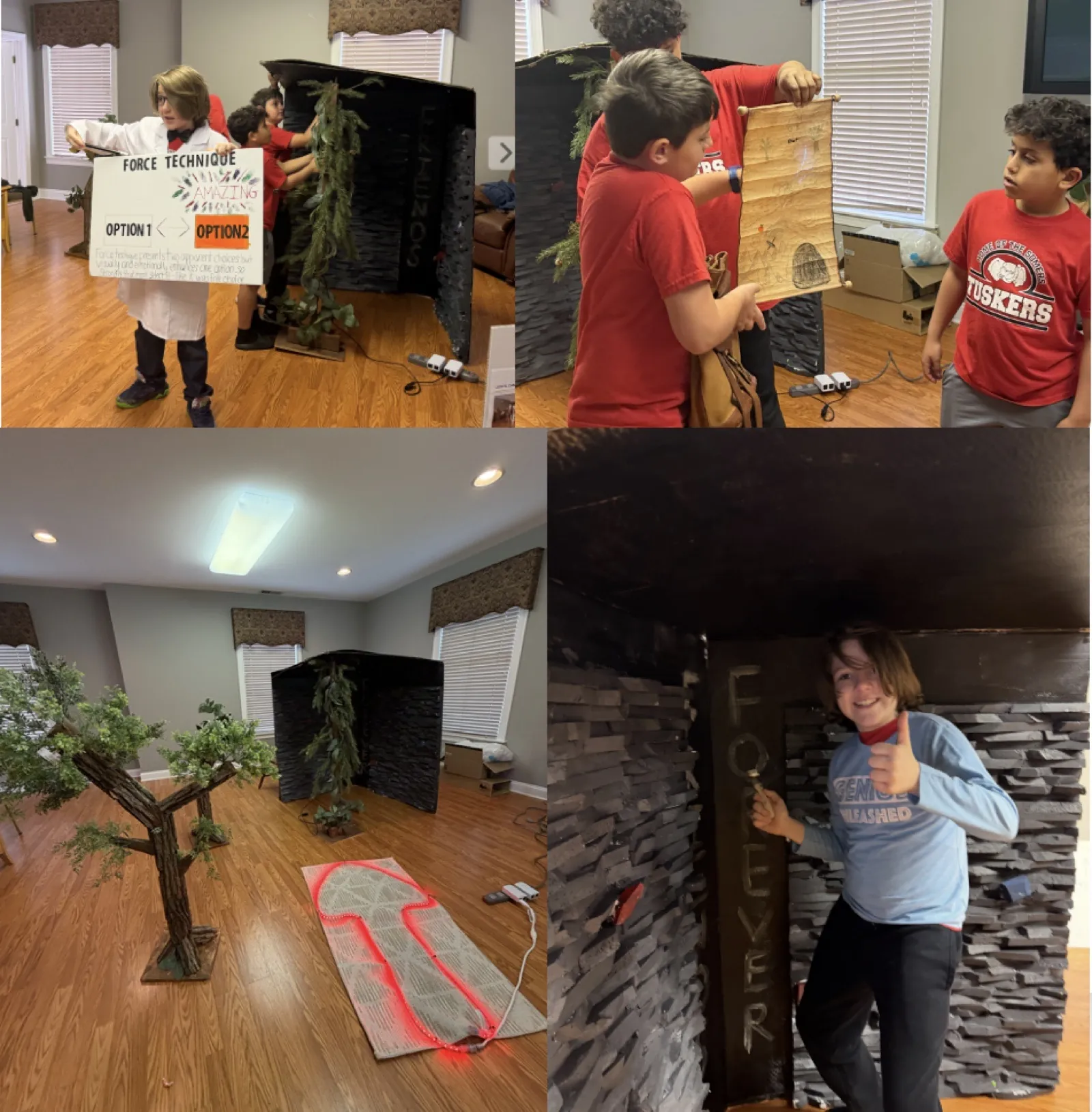 The cave through its build cycle: rehearsing in front of the painted exterior, layering Styrofoam onto the rock face, the assembled structure with the trees nearby, and a glimpse of the textured stone interior the audience never sees from outside.
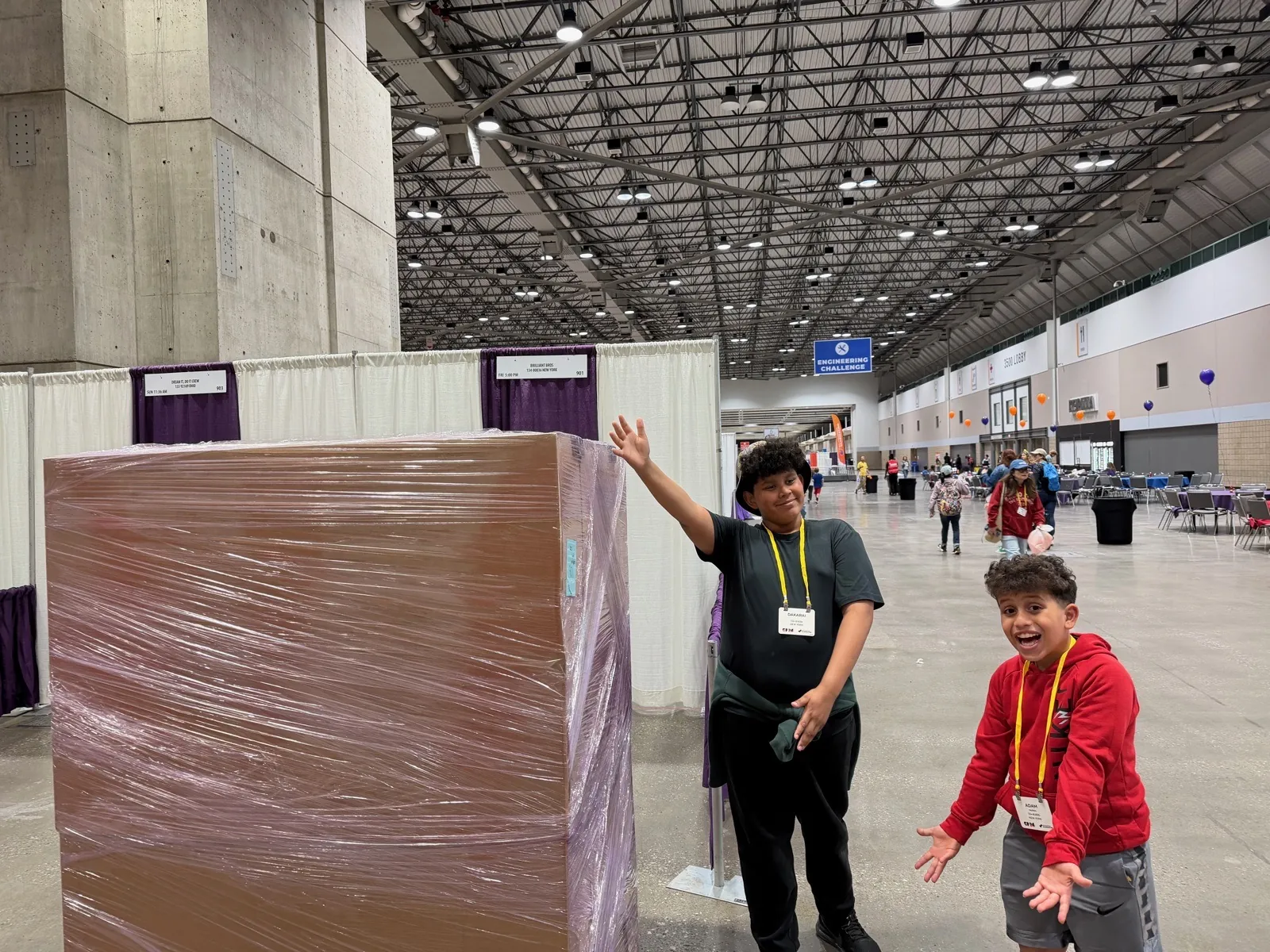 The cave, wrapped and palletized for the freight truck to Kansas City. The whole thing had to fit on one pallet, weight-limited and shrink-wrapped, and arrive in one piece. It did.
The trees were the second Team Choice Element. They wanted them to look like real woods instead of flat cardboard cutouts, so they wrapped armatures in actual bark stripped from fallen branches and painted the leaves to match. One of the trees doubles as a structural support beam for the cave, a piece of engineering they figured out themselves when they realized the cave was going to tip without help. The kids designed the support, measured it, and then disguised it as another tree.
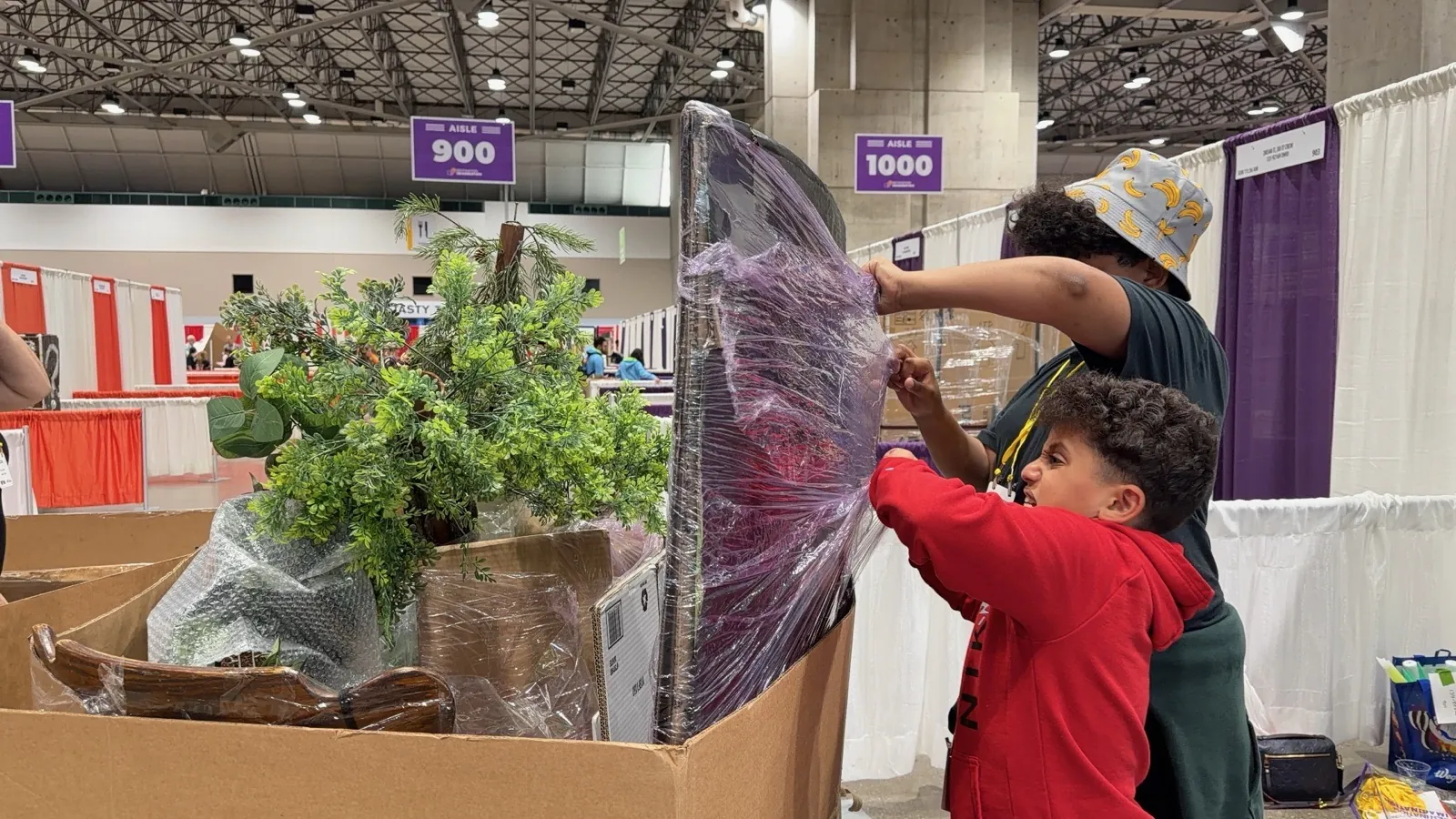 Unpacking the forest at the Kansas City Convention Center. The shipping box on the right held everything: costumes, props, the UV lantern, the orange.
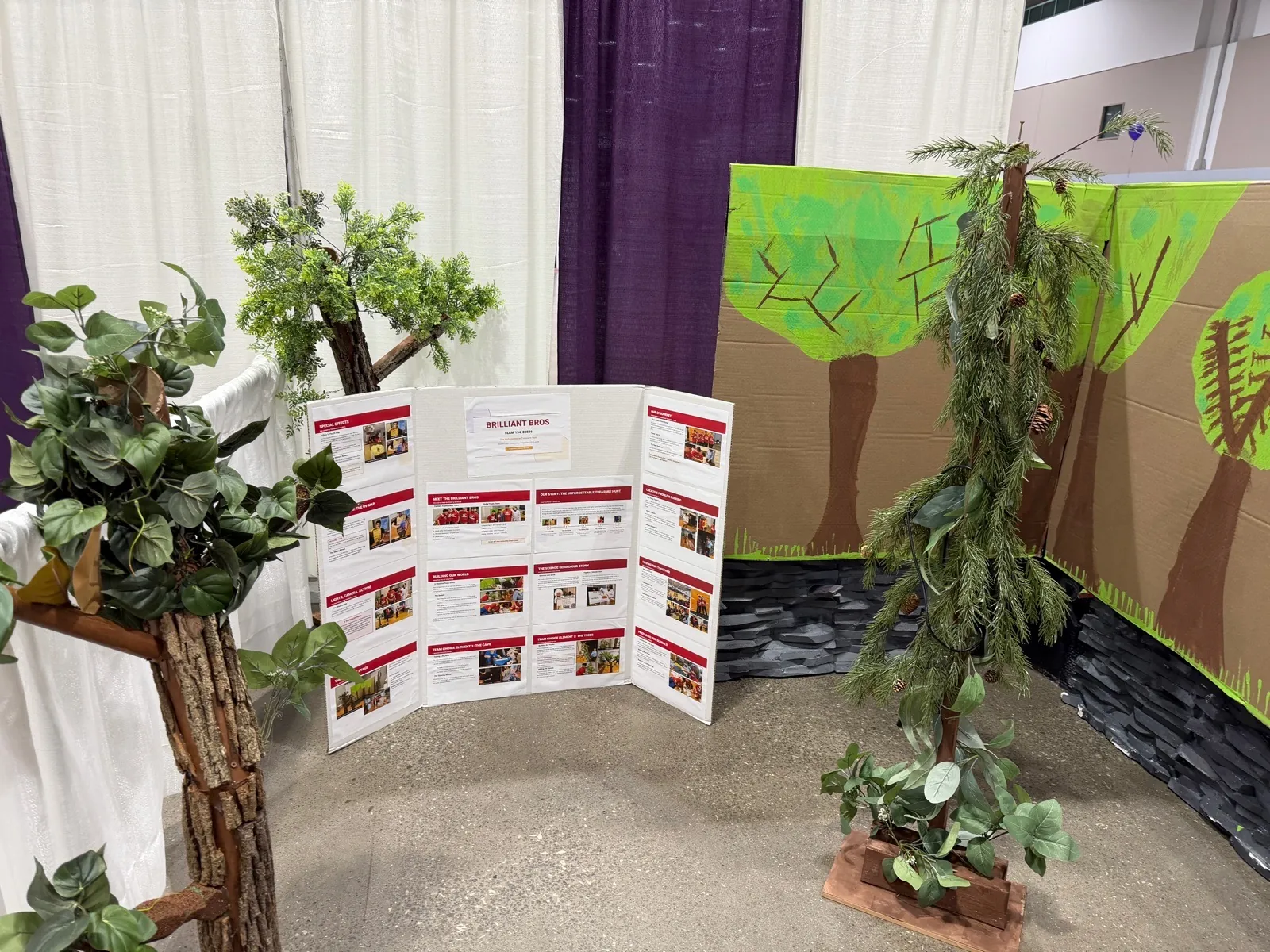 The full set assembled at the Kansas City Convention Center after the team finished unpacking. The trees on the left and right were rebuilt twice between States and Globals.
I want to be careful here, because the rule is that I cannot help and I did not. What parents are allowed to do is teach skills outside of the project. How to use a hot glue gun safely. How to wire a circuit. How to read a tape measure. After that, the kids are on their own. Watching four ten- and eleven-year-olds build a structurally sound, painted, lit, transportable theatrical set without an adult touching it is the kind of thing that stays with you. They argued about geometry. They redid the back wall three times. They figured out, by failing, that hot glue does not hold Styrofoam to cardboard if the cardboard is humid.
Fundraising, and another kind of learning
Globals is not free. Registration, flights for four kids and chaperones, a hotel block, freight to ship a six-foot cave from New York to Kansas City. It all adds up fast. With three new team-members and a freshly reshuffled cast in late March, the families decided the kids would help fund the trip themselves.
What followed was the most surprising part of the season for me. The boys ran a real fundraising campaign. They set up a table outside Bobo's Cafe in Somers and sold raffle tickets for a basket they had assembled themselves, stuffed with gift cards from local restaurants who had donated to the cause. They explained DI to neighbors who had never heard of it. They wrote thank-you notes. They tracked donations.
They also launched a GoFundMe campaign with help from their parents [6]. The kids drafted the story, picked the photos, and set the goal. Parents helped them set up the page, share the link on social media, send it to family across the country, and answer the questions about how the platform's payment processing worked. The campaign reached well beyond Somers, with donations from old colleagues, college friends, and family in three different states.
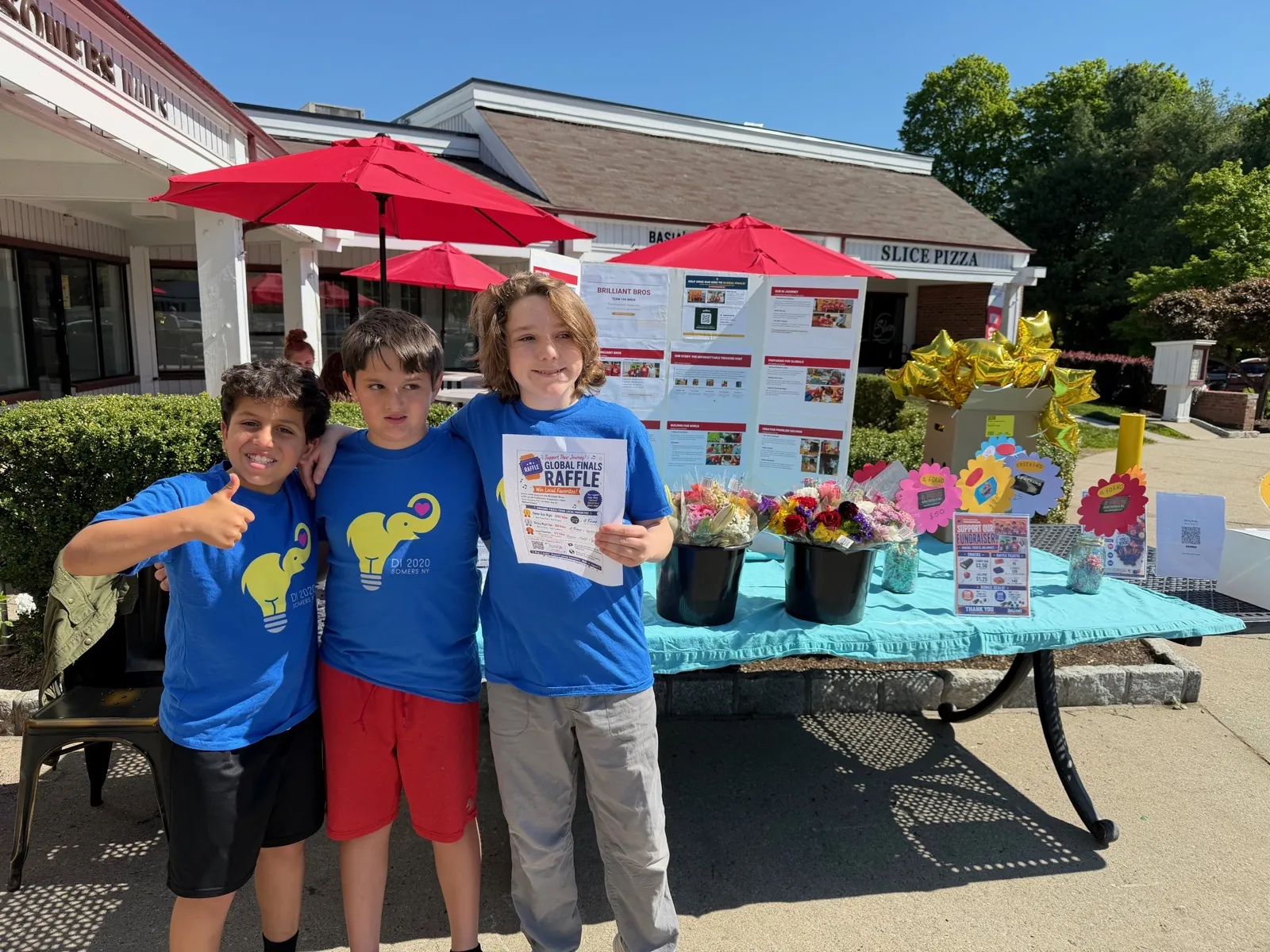 Adam, Jakob, and Joey running their fundraising table outside Bobo's Cafe on a Saturday and Sunday morning. Raffle tickets, flowers, candy, and a tri-fold board explaining the team to anyone who walked by.
By the time they boarded the plane, they had raised over $2,000 toward the cost of the trip. The money came from neighbors, family friends, local restaurants who chipped in gift cards for the raffle, the Somers Record front-page write-up that brought in donations from people who had never met the boys [7], and GoFundMe donors who found the campaign from far beyond Somers.
The first time I saw Adam pitch a stranger on why a Destination Imagination team from Somers needed twenty dollars to go to Kansas City, I learned something about what nine months of this program builds in a kid that no homework set can build. It is the willingness to walk up to someone and ask.
The road through New York
Their season had two qualifying steps before Globals.
The Eastern New York regional tournament in March was their first time performing the script for strangers. They placed well enough to advance to the New York State Affiliate tournament, where they finished 2nd in the state in the Scientific Challenge with a total score of 362.19 points [5]. That finish earned them the invitation to Global Finals.
The cast change happened after States. Eight weeks to rebuild: re-blocking the script around Dakarai and Joey, re-rehearsing every transition, re-running every Instant Challenge drill, and somehow also raising money to get there. The Somers Record covered them on the front page the week before they flew out [7].
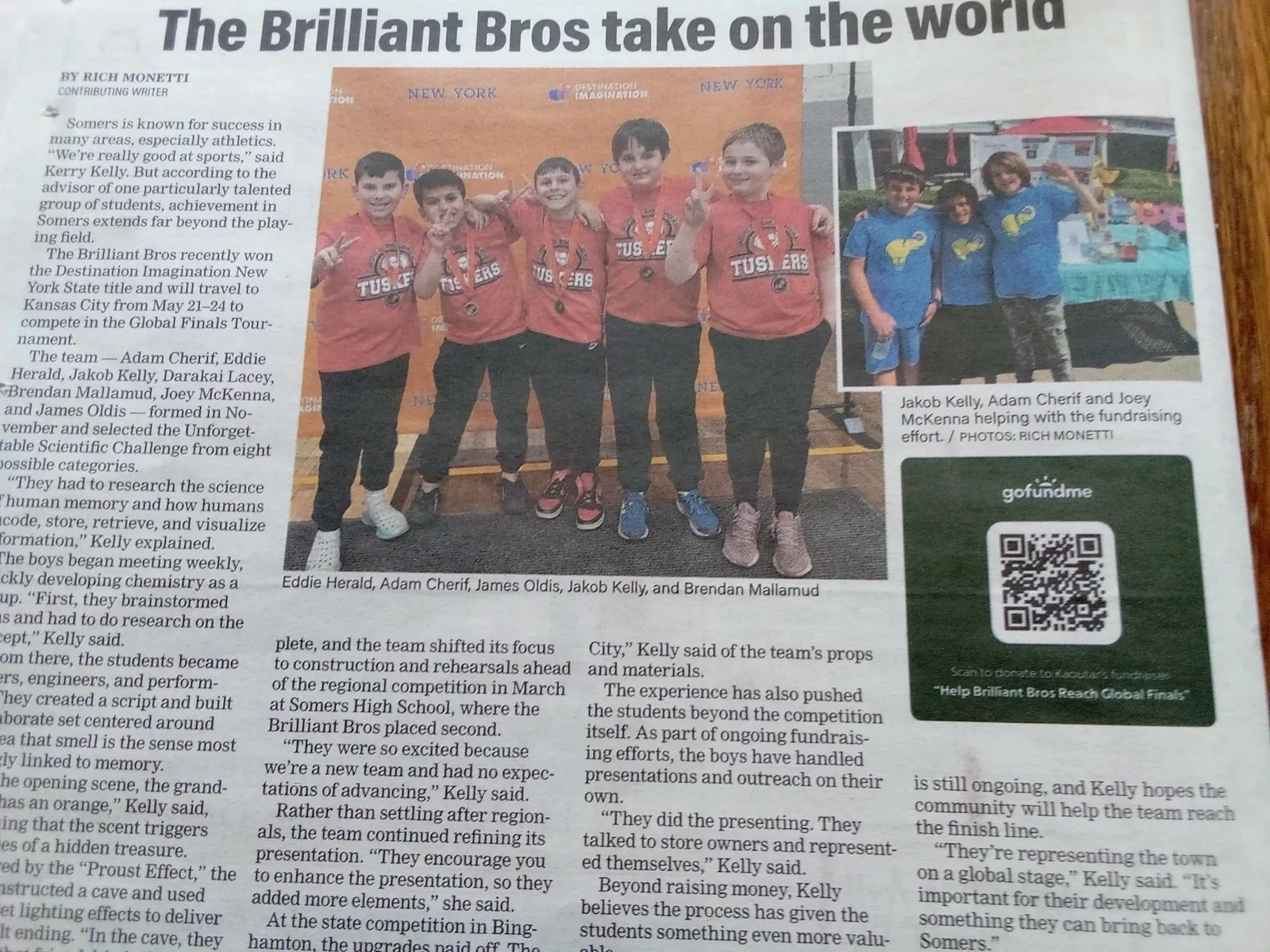 Front-page coverage in the Somers Record the week before the team flew to Kansas City.
Kansas City
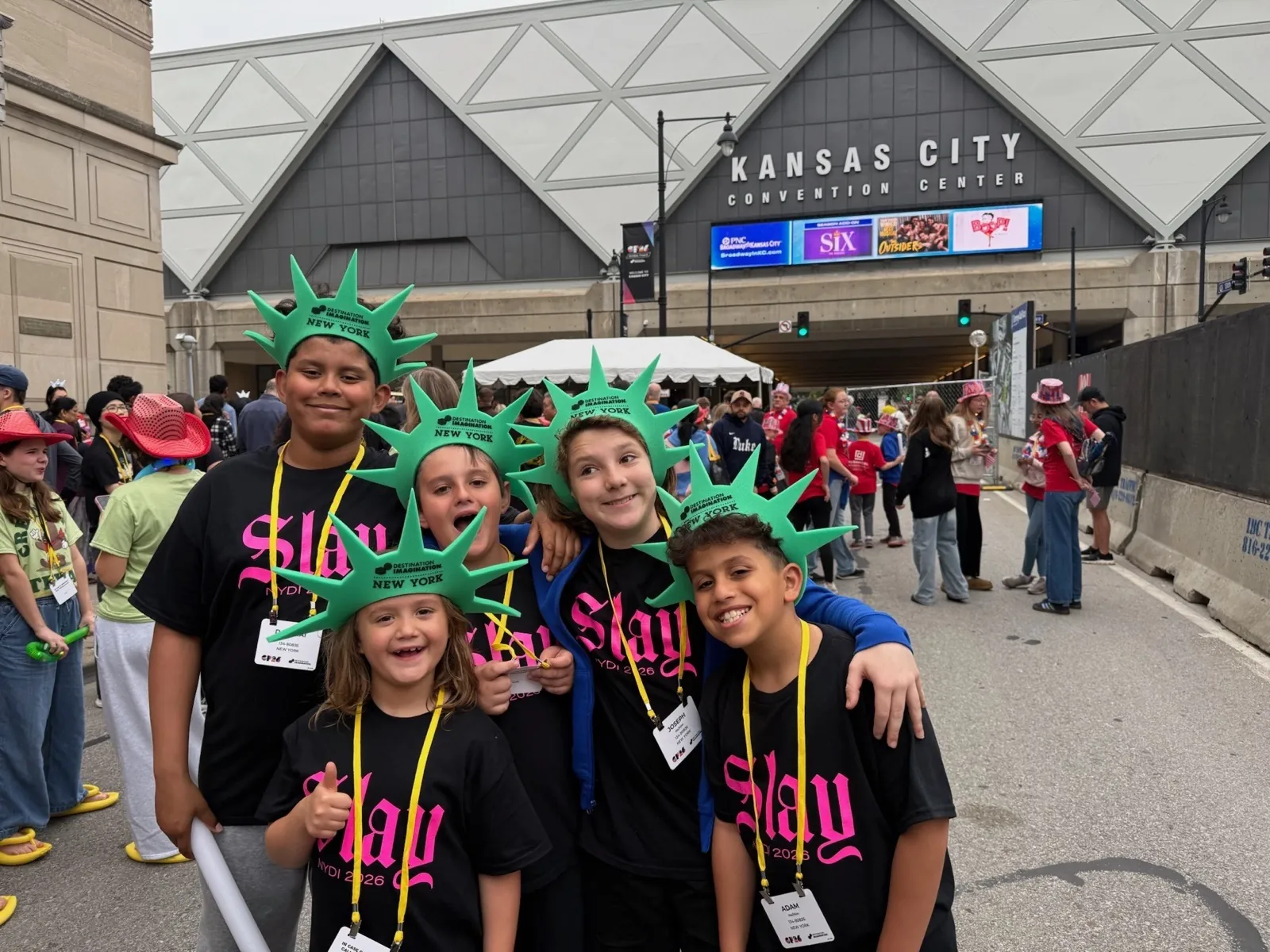
Walking into the Kansas City Convention Center on day one of Global Finals is something. The building is huge. Teams from Mexico, Guatemala, Quebec, Ukraine, China, South Korea, Poland, Australia, Turkey, the Netherlands, and many US states were swarming the lobby in matching shirts and custom-made hats. New York's affiliate had organized matching black "SLAY New York 2026" t-shirts and foam Statue of Liberty crowns for the parade of nations.
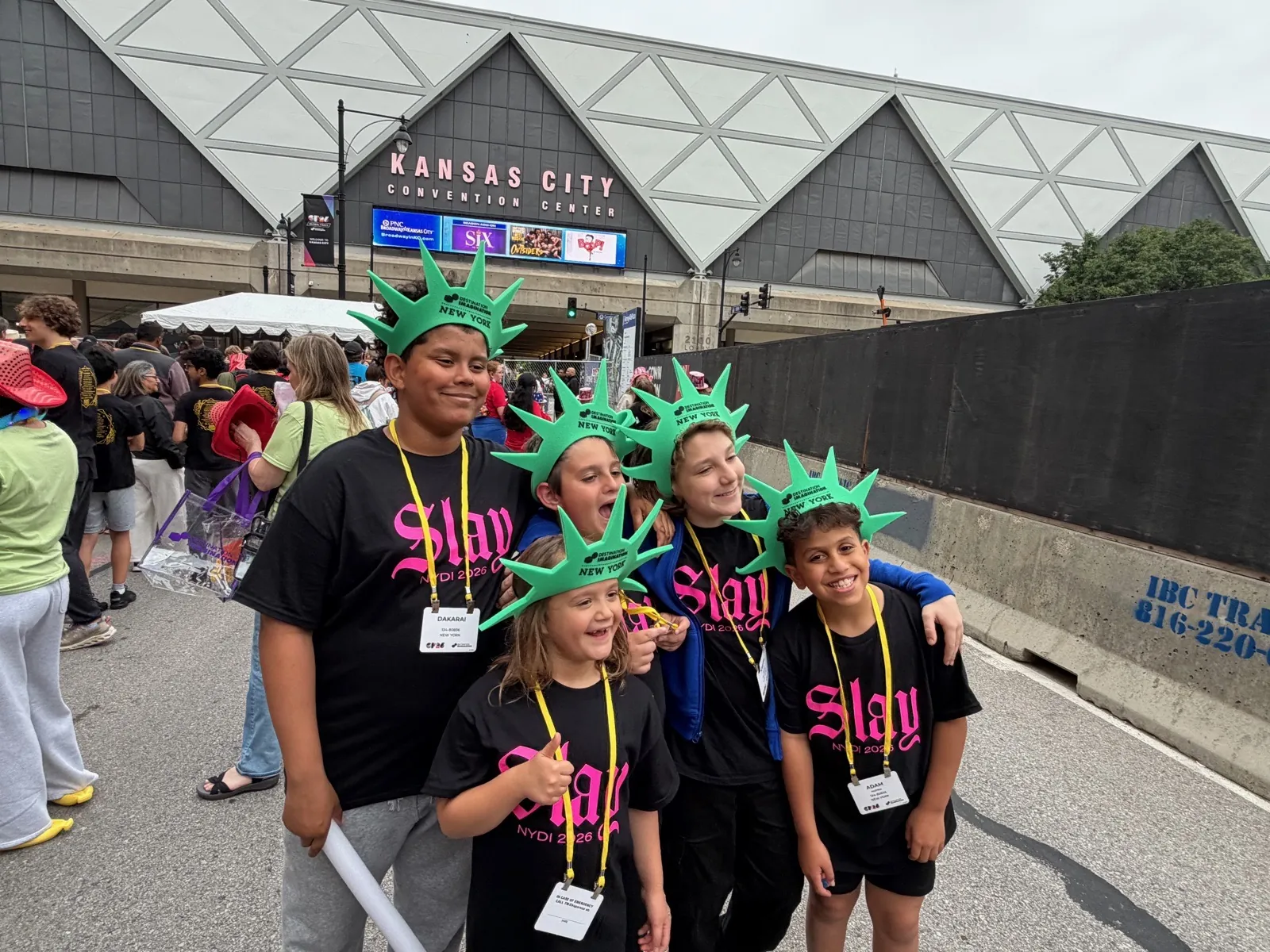 The Brilliant Bros getting ready with big smiles before the opening ceremony, proudly wearing their New York affiliate SLAY shirts and Liberty crowns.
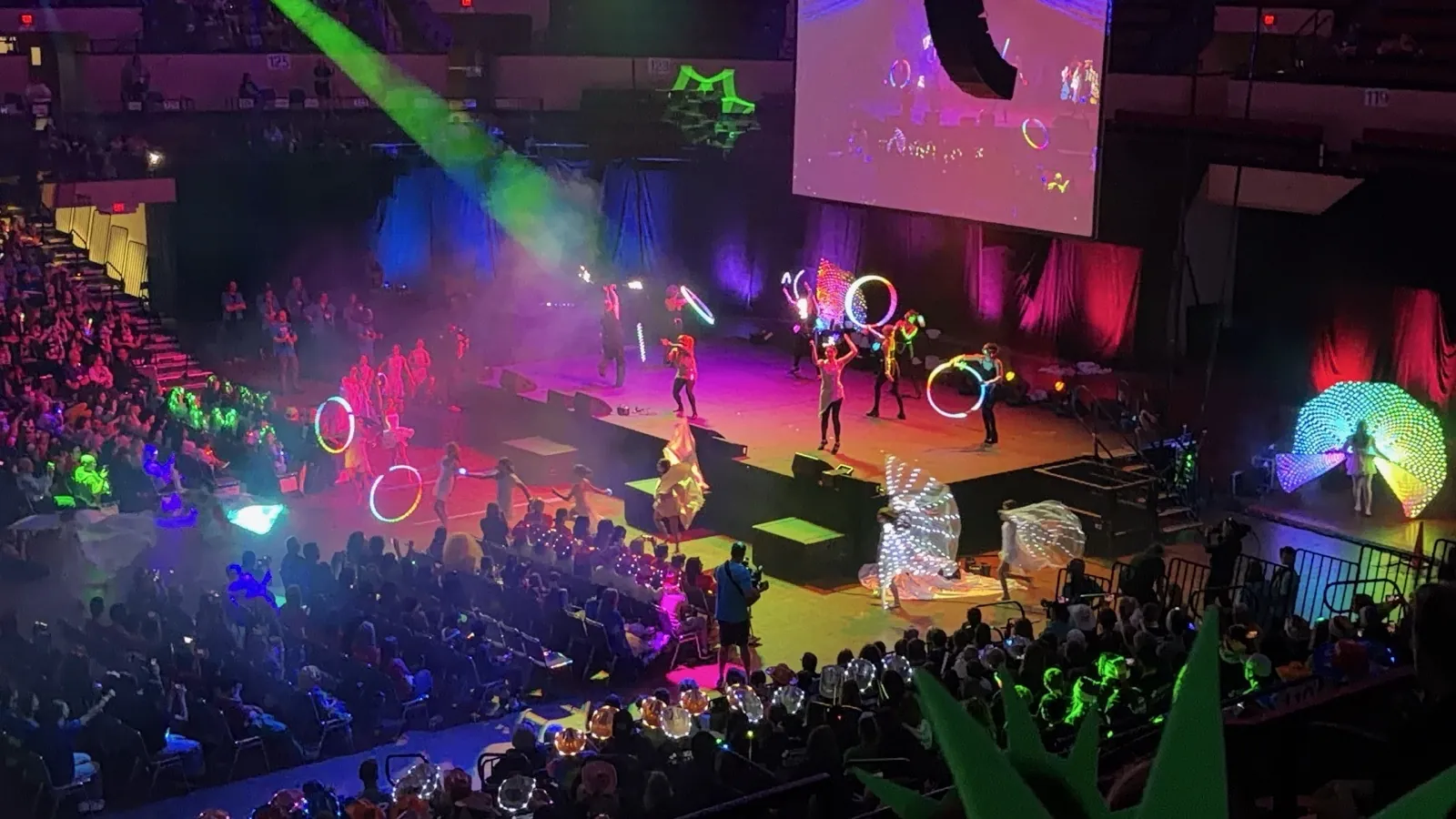 The opening ceremony in Municipal Auditorium. Eight thousand kids, lasers, drones, fire and light performances, and a glow-stick routine that Adam still talks about.
The performance slot itself is short. You get about ten minutes total: eight for the play, plus setup and tear-down. The cave has to come in on a cart, get assembled with the trees and the painted backdrop, run for eight minutes under stage lights, then come back off so the next team can go. Appraisers sit in the front and score on the rubric. One run, no do-overs.
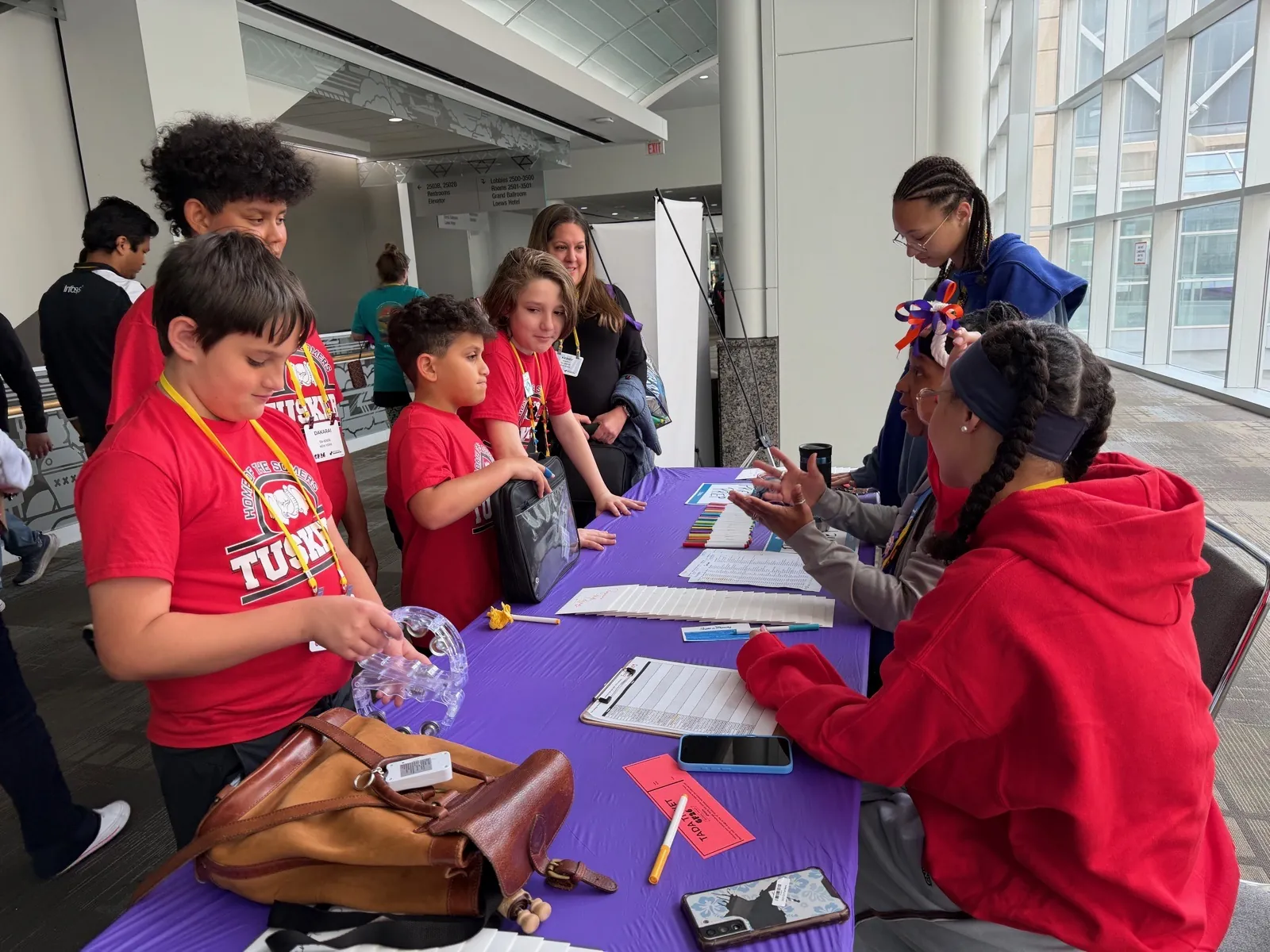 Checking in at the registration table before the Team Challenge performance, with paperwork, badges, and a last review of the run order with the tournament officials.
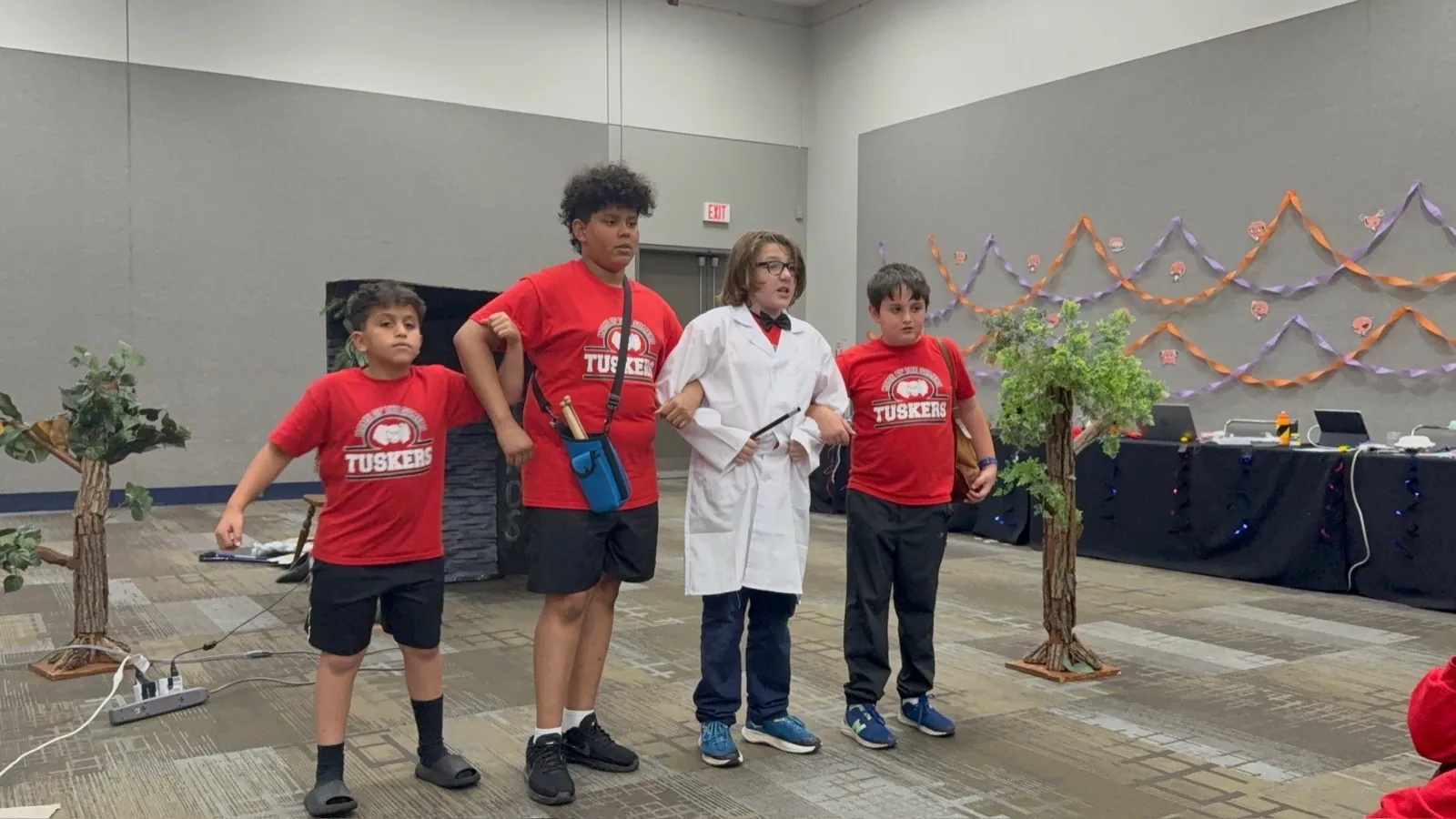 On stage during the Team Challenge: Adam in red as the mischievous friend, Dakarai with the map as the main character, Joey in the lab coat as the on-stage scientist and narrator, and Jakob as Jake doubling as Grandpa. The cave and the trees are the Team Choice Elements.
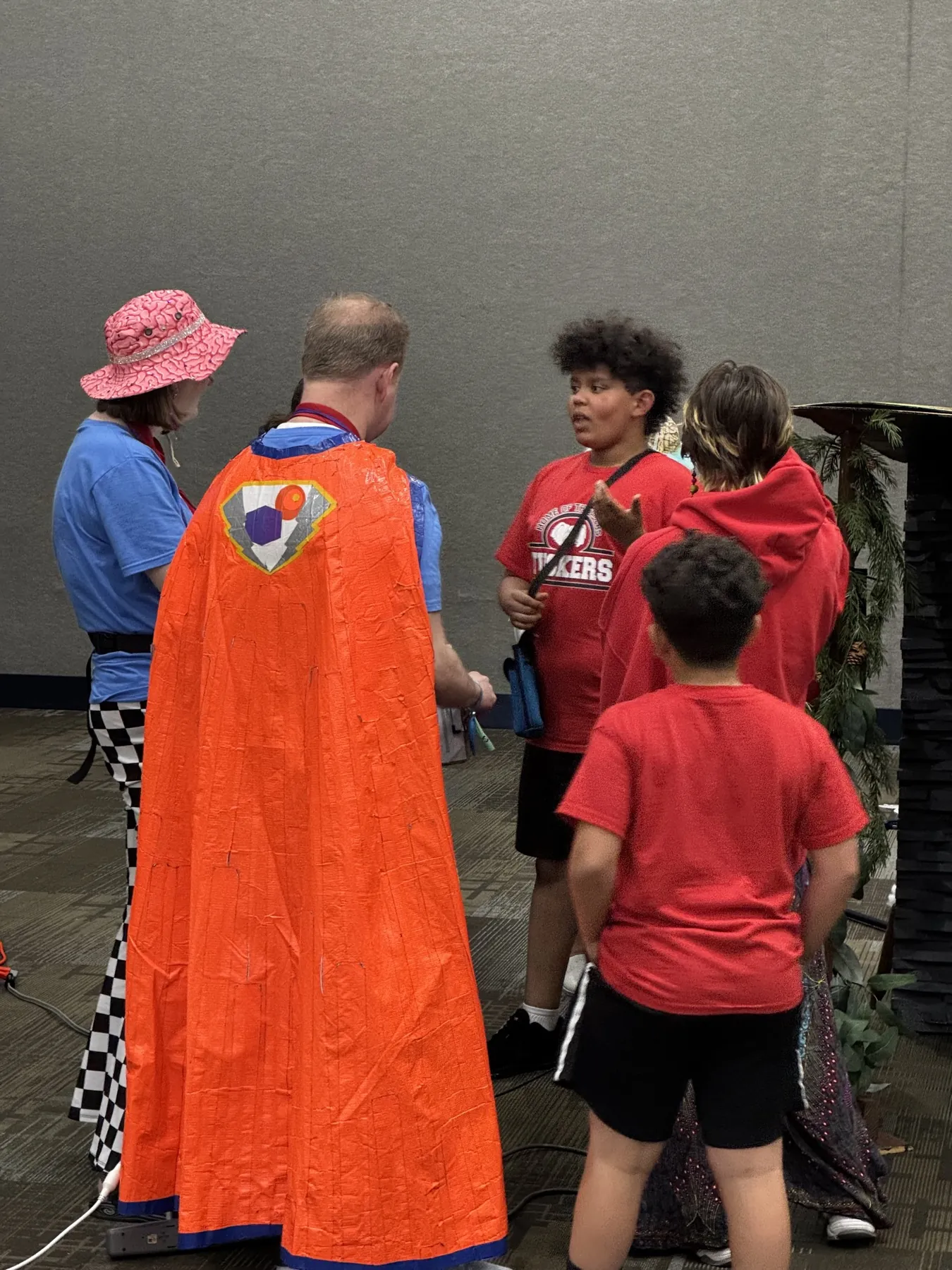 After the performance, the boys sat down with the appraisers and walked them through the solution: the script, the props, the Team Choice Elements, and the research behind the memory science. The interview is part of the rubric, and they treated it like part of the show.
The Instant Challenge happened before their performance. Separate room, sealed problem, no audience. The team walked in, was handed the prompt, and had eight minutes to deliver a solution. They are not allowed to tell us what the prompt was, even now. What they could tell us is that something they did in that room caught the appraisers' attention. Out of roughly 50 teams in their category, the Brilliant Bros were the only one selected to repeat their Instant Challenge performance on camera, to be filmed and featured on the Global Finals stage as an example of superior problem solving and on-the-spot performance. The four of them did not really process what that meant until later, when their video went up on the jumbotron during the closing ceremony.
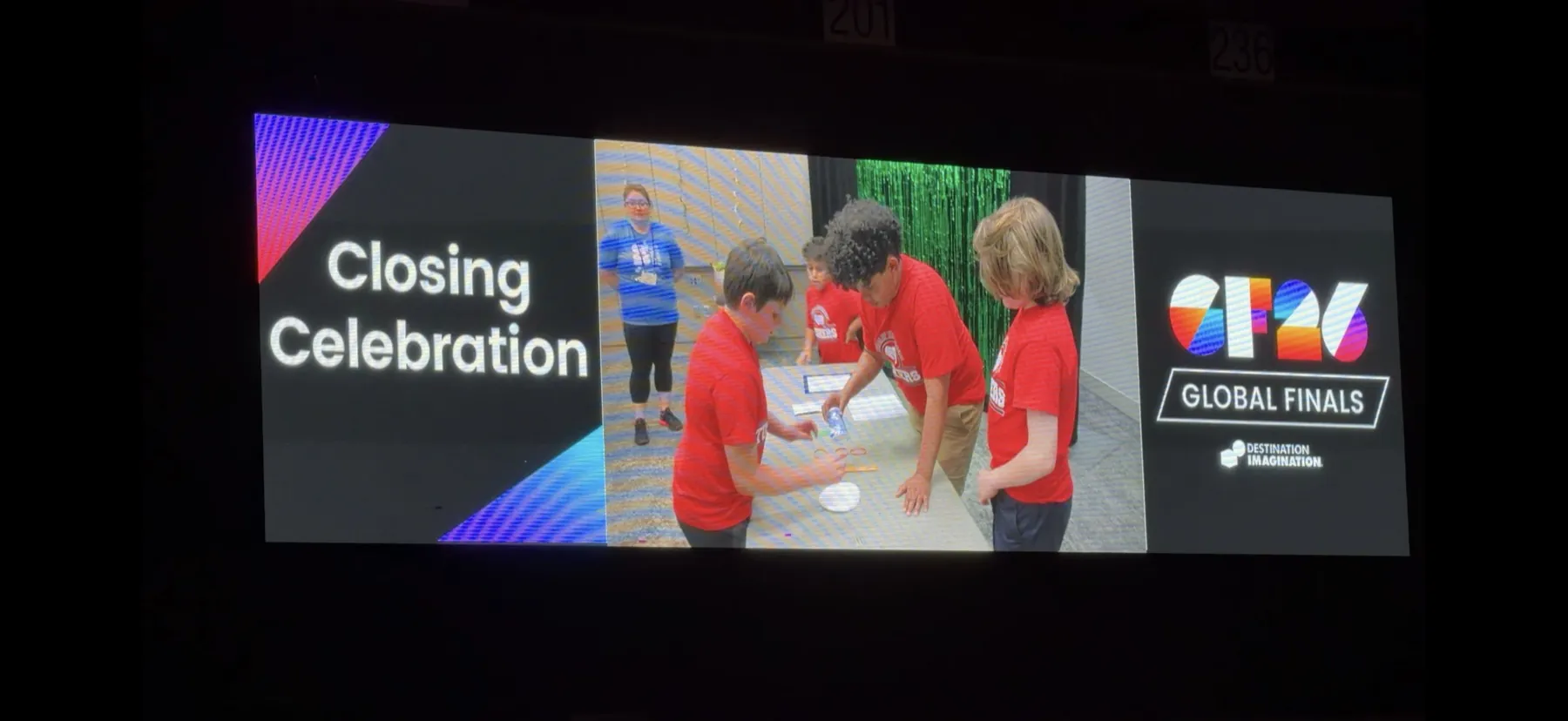 The Brilliant Bros' Instant Challenge moment, projected on the big screen at the closing ceremony as one of the featured Instant Challenge performances of Global Finals 2026.
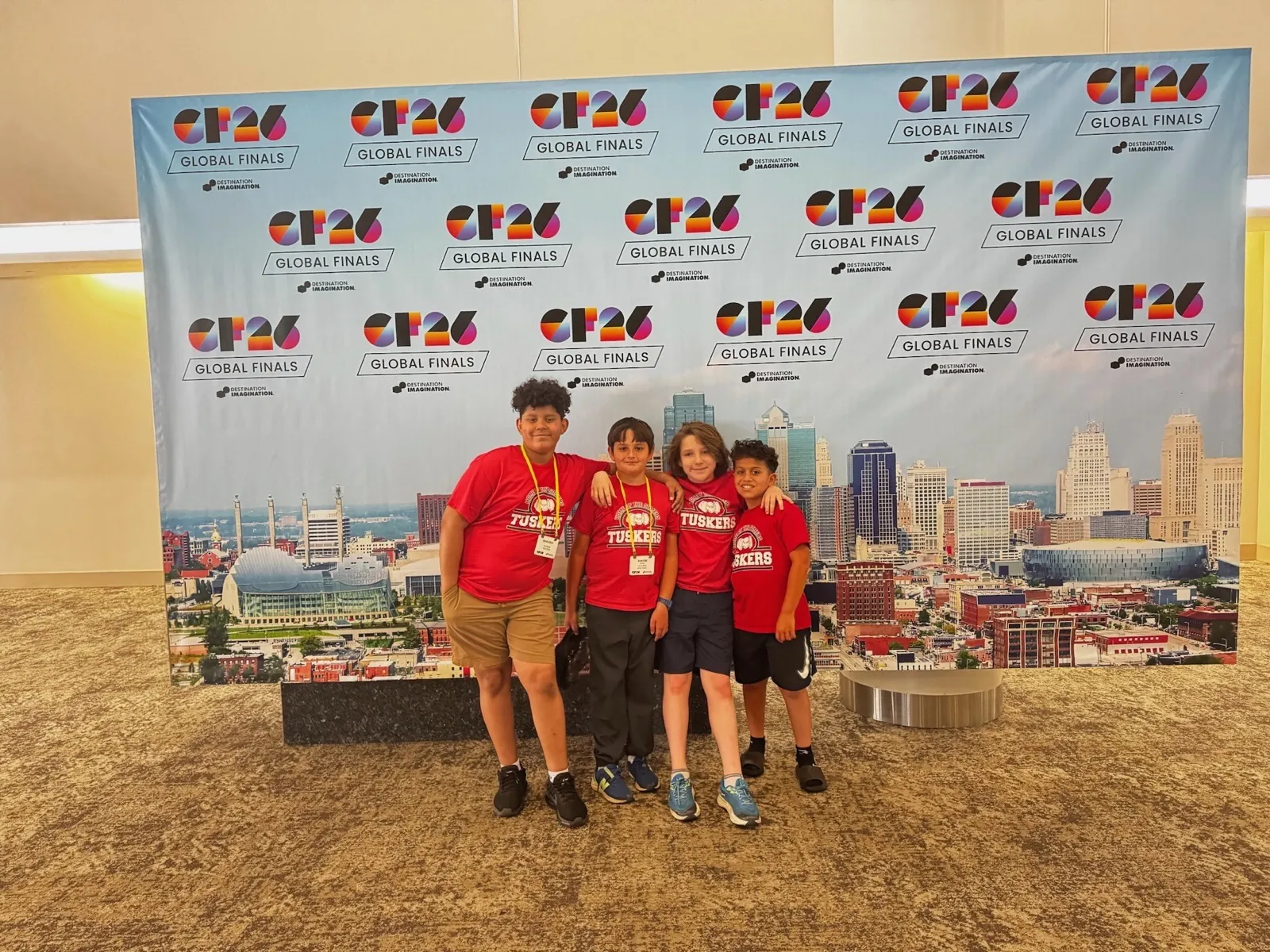 The team after coming off stage, posing in front of the CF26 Global Finals backdrop on the convention center floor. Tired, relieved, and ready to enjoy the rest of Globals.
Pin trading: the unofficial fifth event
Pin trading is a tradition at DI Globals that runs alongside the official competition like a parallel game. State affiliates and many countries produce their own enamel pins each year, and kids buy them at the DI events to trade with everyone else. Walk into the convention center and you will see kids carrying lanyards, Ziploc bags, and cloth display banners covered in pins, and spending hours every day swapping with kids from other places [8]. DI even has volunteers called Pin Backers who help newcomers learn the etiquette so a first-year team does not get traded into a bad deal.
The currency is curiosity. A New York pin trades for a Turkey pin. A Texas pin trades for a South Korea pin. A rare one trades for two ordinary ones. There is no official scoring, but the social economy of supply and demand is real. Trades happen on the floor, in hallways, between sessions, on the convention center carpet for hours at a time.
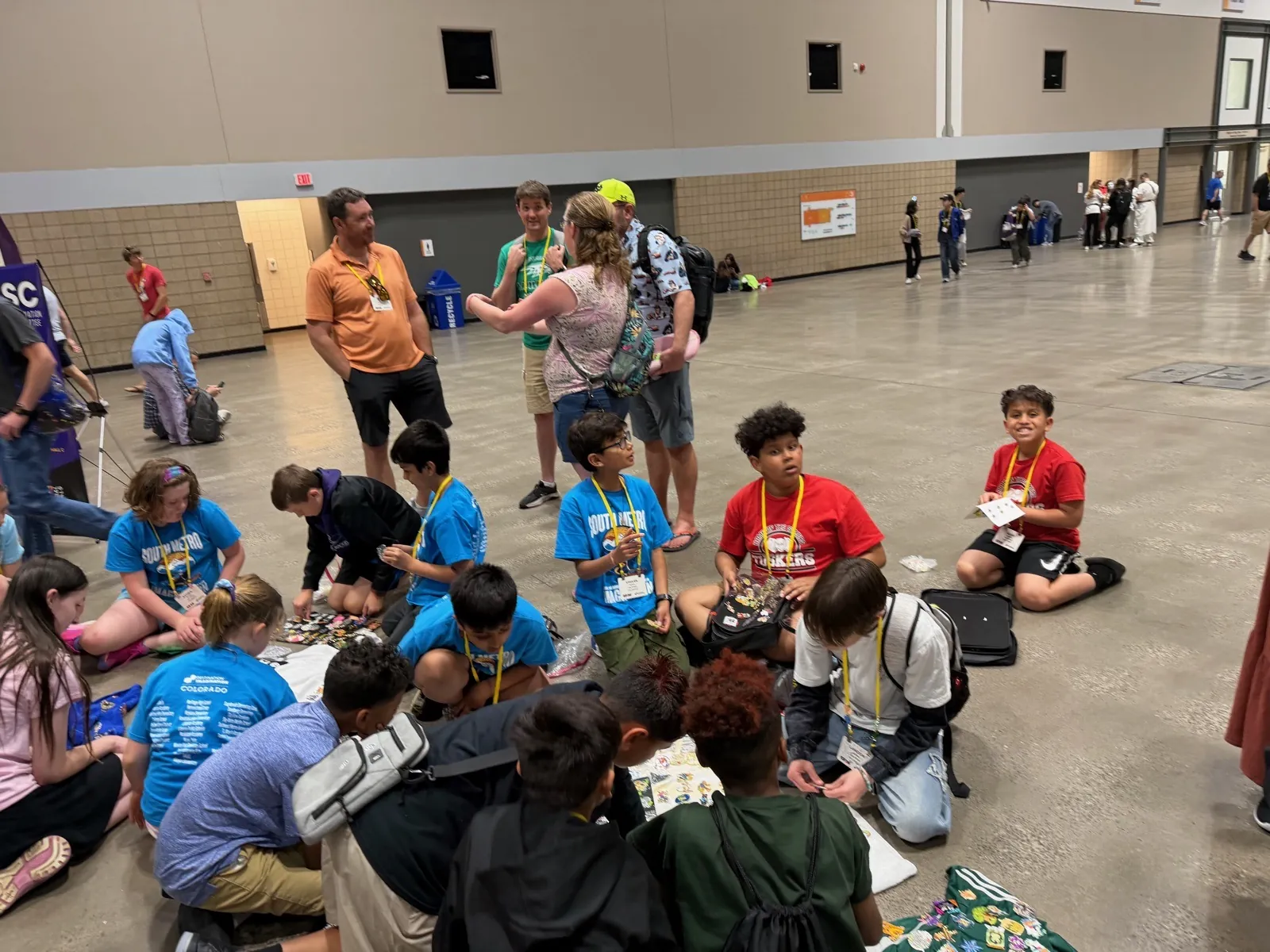 A pin trading circle on the convention center floor. Adam (red shirt, center-back) deep in negotiation with kids from teams the boys had just met that morning.
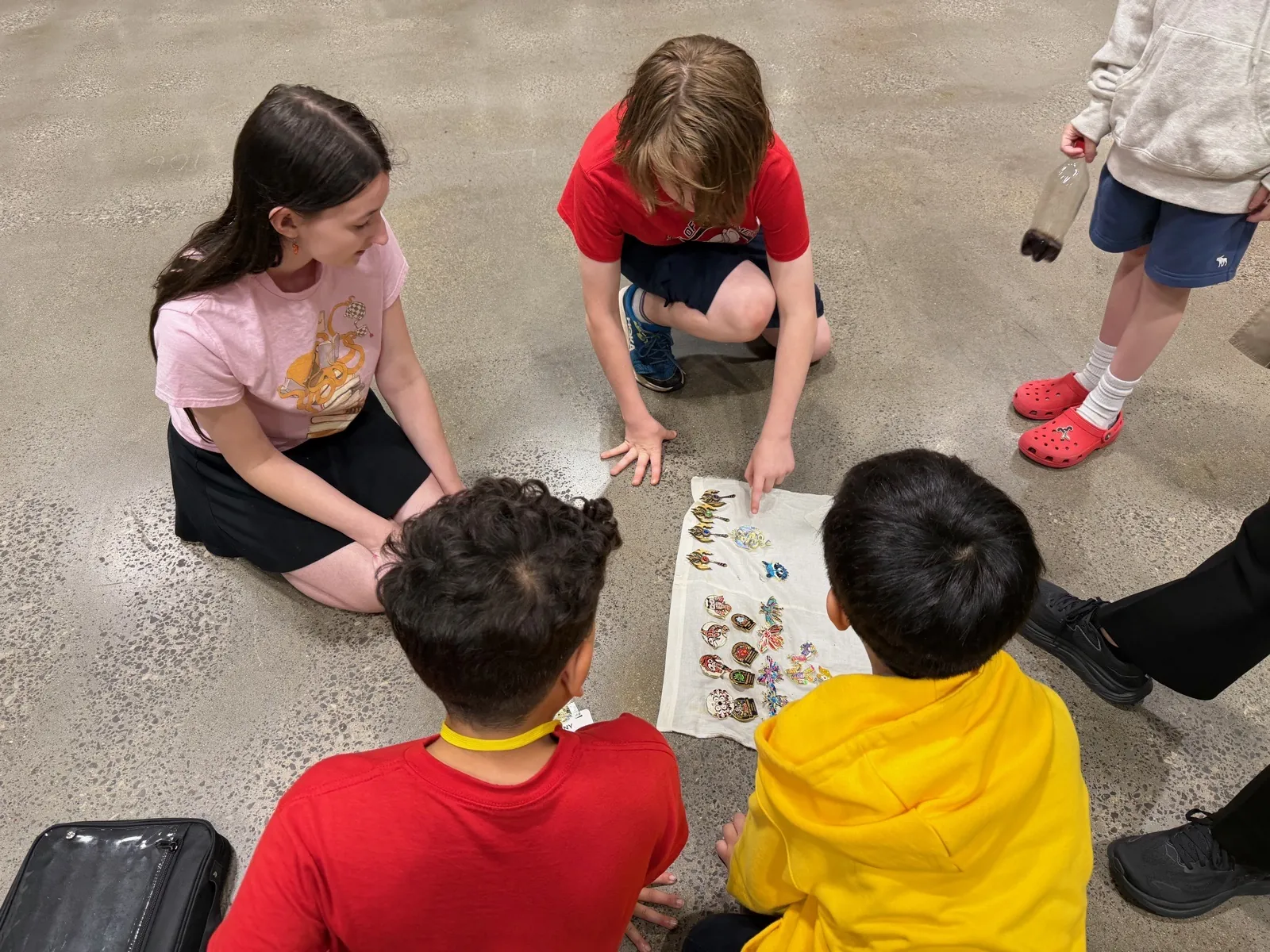 Kids hunched over a display cloth, comparing collections. Affiliates and countries each have their own pin designs for the year, and the rarer the design the harder it is to acquire.
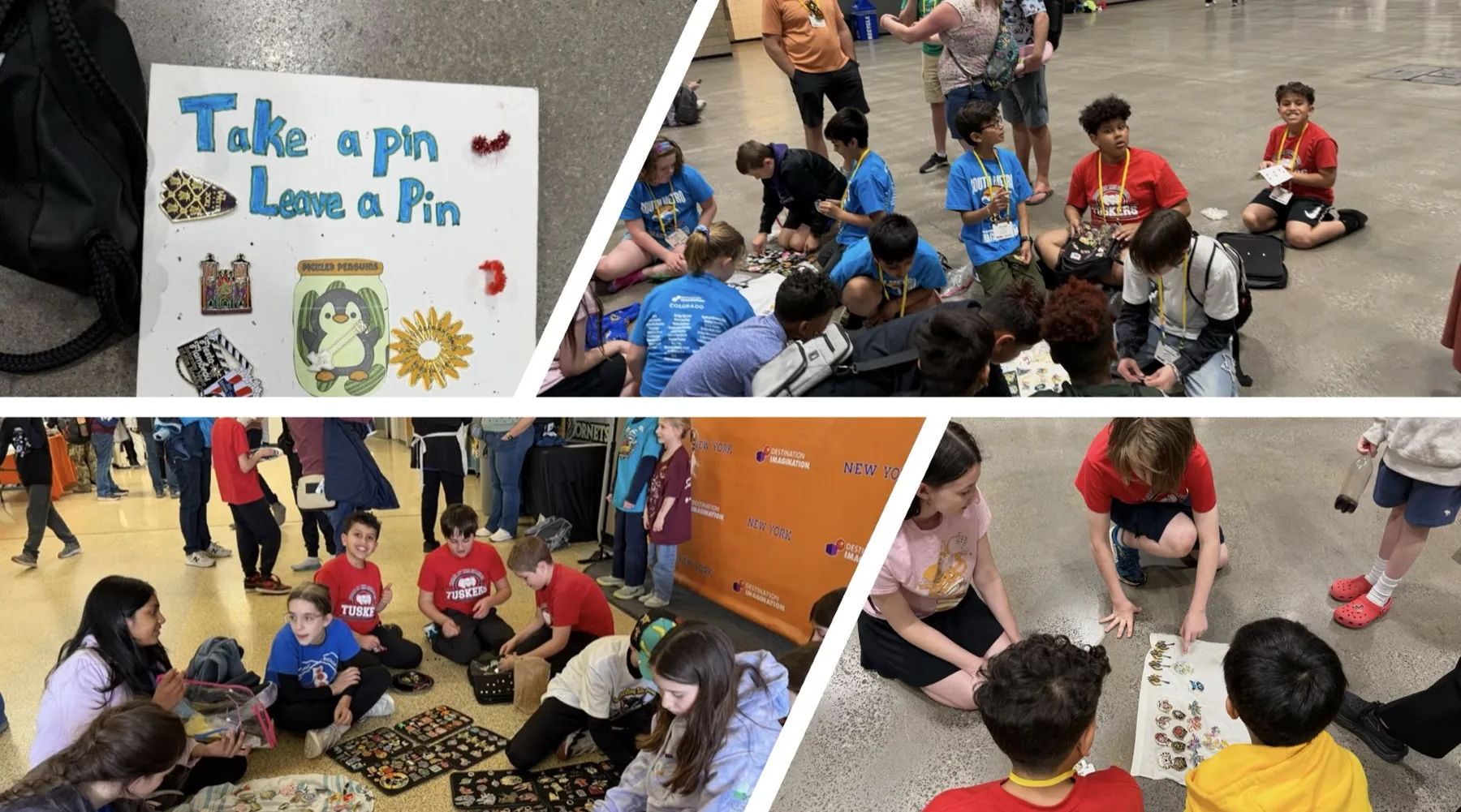 A collage of the pins the boys collected over the week: New York, Texas, South Korea, Turkey, Mexico, and more. Each pin came with a story about the kid on the other side of the trade.
It works as an icebreaker for kids who would never otherwise have a reason to talk to each other. By day two, Adam was negotiating with kids from South Korea, Turkey, and Mexico, and by day four he could point to each country on a globe and tell me which pin came from which team. That is a kind of geography you cannot teach from a textbook.
The result
When the closing-ceremony scoreboard came up on the jumbotron, Brilliant Bros, Somers CSD, New York read 10th place in the world in the Scientific Challenge at the elementary level. Tenth out of every elementary team that qualified, across all the states and countries represented at Globals.
A first-year team of four kids who had never done this before. Tenth in the world.
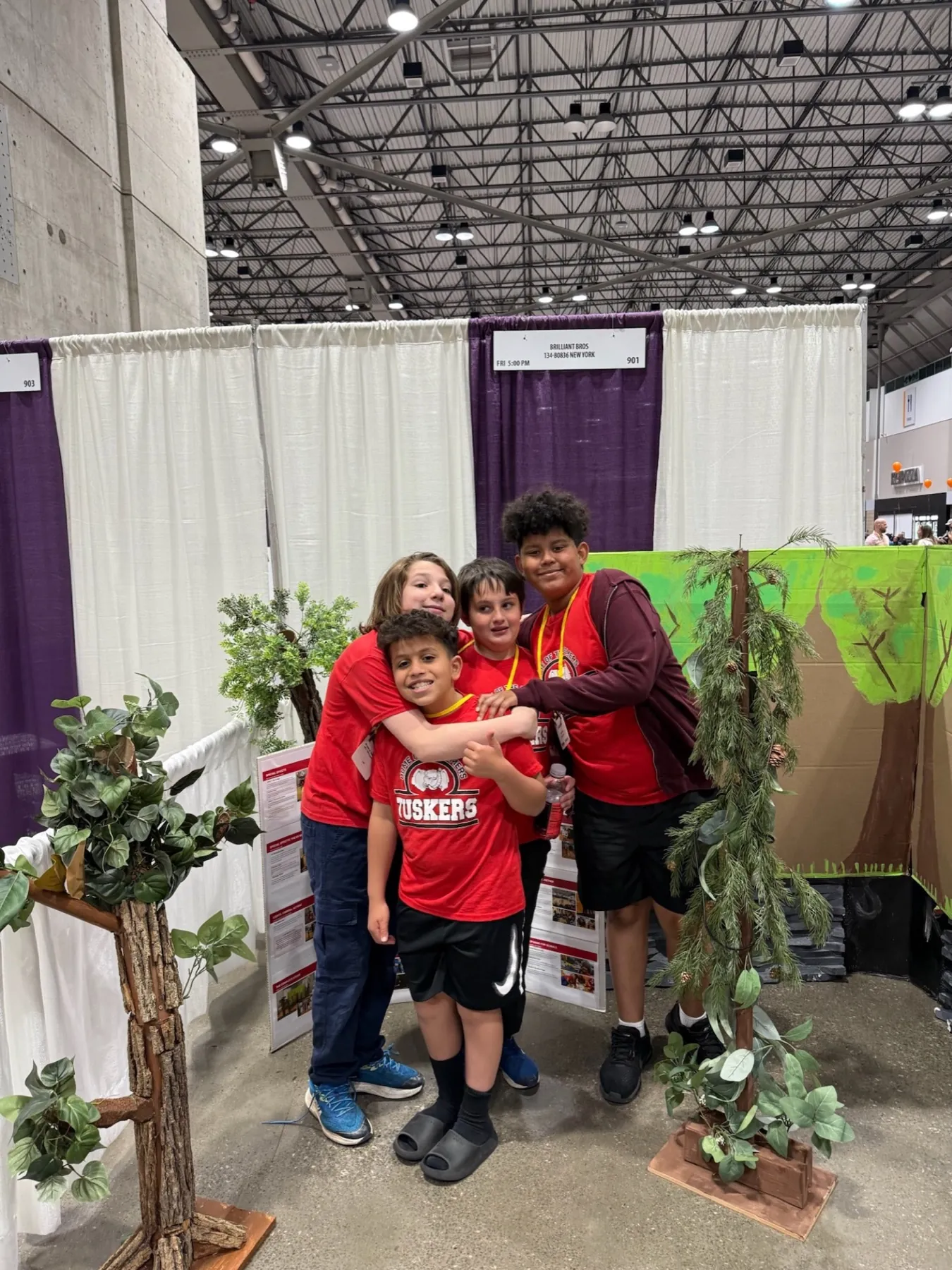 Backstage with the set on the first day, before the opening ceremony. Eight months of building, two flights, and one freight pallet, all unpacked and ready for the stage.
What I keep thinking about as a parent
I write about technical topics for a living. Writing about my own kid is harder than writing a research paper, and that is not a sentence I expected to type.
The thing I underestimated, going in, was how much of this would have nothing to do with the trophy. The trophy is real, and I will not pretend it does not matter. They earned it and they deserved it. But the trophy is a few hours of their year. The other part is the eight months of weekends where four boys, on their own, learned how to argue without breaking the friendship. How to take notes from a coach without arguing back. How to redo work that was almost good enough. How to memorize lines, project to the back of a room, and stand still while someone else talks.
Every one of these boys has grown a lot this season, and I am proud of what they pulled off together. Adam in particular has changed. At the start of the year he was nervous about being on stage at all. By the end he was the one delivering the misdirection scene, the most physically demanding piece of comedy in the play, the one where he has to block the cave from the audience's view with his body and his arm gestures while the narrator explains over him what force technique is in stage magic. He nailed it every time. Watching him do it in front of a global audience, I could not always tell if I was crying because I was proud or because I had not realized how much he had grown until I saw him do it.
There was also the moment after they came off the floor for the last time, when all four of them and their coach folded into one big hug behind the curtain, and none of them said anything for a while. That is the picture above. I keep coming back to it.
The trophy is a few hours of their year. The eight months around it are what they get to keep.
What DI gave them that school does not
I am a research scientist. I work on things that take years, and sometimes do not work. The skill I want for my own kid most, the one I cannot teach in a homework-help session, is the willingness to do hard, ambiguous work over a long stretch of time without knowing if it will pay off. Schools test on the answers. DI tests on the journey.
They learned a lot of things this year, in no particular order. How to read a rule book and translate it into a checklist. How to brainstorm without crushing each other's ideas. How to use ChatGPT as a research aid for memory science without copying its output (the team disclosed this carefully on their tournament data form, and I am proud of how thoughtfully they did it). How to fundraise. How to present in front of strangers. How to lose a regional bracket and come back. How to pack a six-foot cave. How to fix a hot-glue joint at 11 PM in a hotel room. How to be a good teammate when you are tired and someone else got the line.
If you are a parent reading this and your school has a DI program, sign your kid up. If your school does not, you can start one. The official program is at destinationimagination.org, and your state Affiliate runs the regional brackets [1].
A short list of thank-yous
To Coach Kelly, who carried seven boys through eight months without ever telling them what to do, only how to figure it out themselves. To every parent on this team for showing up, weekend after weekend, with snacks, rides, encouragement, hot glue refills, and the patience to hand the work back to the kids when we wanted to fix it for them. You made this season possible. To Somers Central School District for hosting the program and for funding the team's registration so the boys could compete in the first place. To the Somers Record for the front-page write-up [7]. To Bobo's Cafe for letting the team set up a fundraising table out front on a busy Saturday and Sunday morning, and to every neighbor who bought a raffle ticket. To the Somers restaurants who donated gift cards for the raffle basket: Frannie's Goodie Shop, King Kone, Prime Pub, Epstein's Kosher Deli, Il Forno Italian Kitchen & Bar, and Traditions 118. The basket would not have been the basket without you. To Martha Rosen, Noel Allen, Josh Diamond, and Jacqueline Cirieco for guiding us along the journey, and to the principals of Somers Intermediate School, Linda Belger and Kyle Grogan, for letting the team fundraise at the school band concert. Those nights brought in a real chunk of the trip and introduced the team to families who had never heard of DI before. To everyone who chipped in on GoFundMe, especially the friends and family who shared the link further than we expected. To the New York Destination Imagination affiliate for getting them to states and beyond [5].
To Eddie, James, and Brendan: you got them to States. None of this happens without the months you put in. The play we saw on stage in Kansas City started in your hands.
To Dakarai and Joey: you joined a team that was already deep into a season and learned a script, a set, and a new group of friends in six weeks. You belonged from day one.
To Jakob: you and Adam carried the thread of the team across the cast change. That is a kind of leadership that rarely gets named at their age.
And to Adam: I love you, kid. I am very proud of you.
 The team full of smiles with Jake's sister, their biggest supporter, ready to embrace next year's challenge.
References
[1] Destination Imagination, "The Challenge Experience," accessed May 2026.
[2] Destination Imagination, "Global Finals 2026 — May 21-24, Kansas City," 2026.
[3] Destination Imagination, "Preview Our 2025-26 Team Challenges: Scientific Challenge — Unforgettable," March 12, 2025.
[4] Rachel S. Herz, "The Role of Odor-Evoked Memory in Psychological and Physiological Health," Brain Sciences, 2016. Foundational review of the Proust effect and olfactory autobiographical memory.
[5] New York Destination Imagination, "2026 NYDI Affiliate Tournament Results," March 2026. Brilliant Bros (Somers IS), Scientific Challenge — Unforgettable, 2nd place, 362.19 points.
[6] GoFundMe, "Help Brilliant Bros Reach Global Finals," spring 2026.
[7] Rich Monetti, "The Brilliant Bros Take On the World: Somers Destination Imagination," The Somers Record, May 2026.
[8] Frank Begun, "Dr. Frank Begun Talks the History of Pin Trading in Destination Imagination," Destination Imagination Blog, July 2021.
[9] Destination Imagination, "Global Finals 2026 kickoff announcement," Instagram, May 2026. Lists the event scope as 10,000 people, 600+ teams, and 11 countries.
Discussion
Sign in with GitHub to leave a comment or react. Threads are public and live in this site's GitHub Discussions.